Thursday, August 27, 2009

James H. Lane: soldier of misfortune

Image from bioguide.congress.gov

Like William Hull, James Henry Lane could be considered as much or more of a military man than a politician. Though he had considerably more political experience than Hull, Lane nevertheless spent much of his time in the field. Ultimately, it was a mix of both political and military issues that led to Lane's downfall.

Lane was born in Lawrenceburg, Indiana, in 1814. After attending school and studying law, he was admitted to the bar in 1840 and opened up a practice in his hometown. While there, he became a member of the city council and speaker of the Indiana house of representatives. Six years after opening his practice, Lane left to join the Third Indiana Volunteers. Ultimately, he became a colonel and served in the Mexican War, leading a brigade at the Battle of Buena Vista. Upon returning home, Lane raised the Fifth Indiana Volunteers and served as Lieutenant Governor from 1849 to 1853.

Lane left this position after being elected as a Democrat to the House of Representatives in 1852. He served one term, during which his most noted vote was one in favor of the Kansas-Nebraska Bill and the repeal of the Missouri Compromise, an act that led to the "bleeding Kansas" struggles between pro- and anti-slavery settlers in the territory. Not one to shy away from trouble, Lane moved to the Kansas Territory after his term in the House and joined the anti-slavery "free state" faction.

In 1855, Lane became the chairman of the executive committee of the Topeka constitutional convention, which formed the first state government. He was also elected major-general of the Free State Troops, and organized the defense of Lawrence during the conflict in late 1855 known as the "Wakarusa War." The key feature of the defense was a network of rifle pits throughout the settlement's streets, ensuring that any attacking pro-slavery army would pay a high price. In a speech after Lawrence's successful defense from Missouri raiders, Lane declared, "That beloved Union, for the safety of which we trembled, will not again, we trust, be imperiled by a foreign force from a sister state invading our Territory. They must and will see the impropriety and injustice of meddling in our affairs until they become our fellow citizens."

Lane was known for such speeches in his efforts to encourage anti-slavery settlers to come to Kansas and in his general denunciation of slavery. In an 1856 speech, Lane blamed Franklin Pierce for the bloodshed, since the territory had been rejected for statehood, and arraigned the President as a murderer. The accusation referred to the government's decision that year to not recognize a memorial presented to Congress requesting statehood. Senator Stephen A. Douglas of Illinois accused Lane of perpetrating fraud, since the memorial was plagued with added sentences and several signatures that appeared to be in the same handwriting. An incensed Lane challenged Douglas to a duel, but Douglas refused to accept, saying Lane was not a Senator and therefore not his equal. The rebuke was especially cutting because the Topeka government had appointed Lane to sit in the Senate if statehood was granted. According to John Speer, a compatriot and biographer of Lane, Douglas and Lane eventually became friends due to the approaching Civil War, and Lane mourned Douglas when he died a few months after the conflict began.

Lane continued his activities against pro-slavery men in Kansas, earning him the nickname "The Grim Chieftain." When raiders sacked Lawrence in May of 1856, Lane gathered troops from Iowa and Nebraska and entered Kansas to bolster the anti-slavery forces and drive out raiders. During the same month, Lane was indicted for high treason. The New York Times, in Lane's obituary, reported that Douglas County handed down the indictment for Lane's support for the Topeka government, while historian Donald L. Gilmore says the indictment was handed down by a U.S. district court chief justice who charged Lane and a number of other anti-slavery leaders with resisting territorial laws.

The indictment led Lane to keep out of sight more than usual, but by the next year he was back on the scene, assisting with efforts to remove raiders from Bourbon and Lion counties. He served as president of the Leavenworth constitutional convention, and was elected major-general of the Kansas troops by the territorial legislature. Lane also corresponded with John Brown during 1857, appointing him a brigadier-general and encouraging him to come to the territory to fight. Brown declined, as he was making preparations for his famed 1859 raid against Harper's Ferry in Virginia.

Lane's first serious trouble came in June of 1858, when he shot and killed fellow free state leader Gaius Jenkins as Jenkins came onto land that both men claimed in order to get water from a well. According to Lane's account, Jenkins was accompanied by three other armed men, and he did not open fire himself until three shots had been leveled at him, including one that struck him in the knee. Lane was charged with homicide, but ultimately released on the grounds of self-defense. The incident haunted Lane for at least another year, when a public resolution called him a coward and murderer and said the incident "adds one more infamous page to a life of treason, stratagem, and spoils." In a response published in the Lawrence Republican in March of 1859, Lane declared that he had not expected to kill Jenkins. "It is true that Mr. Jenkins fell by my hand," he wrote. "But no one has more deeply felt or grievously mourned that misfortune than myself."

After Kansas was admitted to the Union as a state in early 1861, the legislature elected Lane to the U.S. Senate with 55 votes, a slight majority over Samuel C. Pomeroy, the other man appointed. By this time, Lane had fallen in with the Radical Republicans, who not only opposed slavery but supported civil rights for African-Americans. He had also fallen on poor times. Speer said that when Lane was elected, he was so poor that he "was refused credit for a loaf of bread in Lawrence."

With the Civil War underway, one of Lane's most notable actions was commanding the Frontier Guard. Made up of Kansas troops, the Guard was raised for the defense of Washington, D.C. in the early part of the war. They were even camped in the East Room of the White House for a time, according to the New York Tribune. Lane also sent the men on a few offensive actions, including an attempt to capture Confederate general Robert E. Lee. While this failed, they did manage to capture the first rebel flag of the war from the homestead of a secessionist.

In June of 1861, President Abraham Lincoln nominated Lane to be brigadier-general of the volunteers. Lane accepted, and for four months commanded the Kansas Brigade, made up of three volunteer units. Following the retreat of Union troops at Wilson's Creek and threats of further violence by pro-slavery raiders, Lane gathered troops and fought skirmishes at Dry Wood and Papinsville. He then led the men on to sack Osceola, Missouri.

Lane's military activities back in the West weren't exactly conducive to his duties as a U.S. Senator. Following his nomination to be brigadier-general, the Judiciary Committee determined that he "virtually resigned his seat." Governor Charles Robinson appointed Frederick P. Stanton, a former governor of the Kansas Territory, to fill the vacancy. Robinson was not very fond of Lane, resentful of his influence and troop-raising activities, which were not strictly within his authority. Though the Senate considered the question of whether Lane was "not entitled to a seat in this body," the seat remained Lane's when the question was amended in January of 1862 to remove the word "not" and accepted.

Though Lane's hope was to raise an expedition of Kansas troops, Native Americans, cavalry, and artillery to invade the southwestern portion of Confederacy, the idea was abandoned due to impracticality. Nevertheless, Lane continued to see action in the West during the Civil War. In July of 1862, he was named commissioner to superintend the recruitment of volunteers.

One noted result of Lane's recruiting efforts was the First Kansas Colored Volunteers, the first black regiment created in the Union army. He sent agents throughout the Union to raise troops, but ultimately the War Department asked that it be put to a stop after receiving complaints that it was hindering efforts to recruit white men. Undeterred, Lane continued to muster troops without federal or state backing. He even hired black recruiting agents, promising pay equal to their white counterparts. Eventually, the regiment received federal authorization.

Already an enemy of pro-slavery forces in Kansas, Lane's activities and declarations (including one that overthrowing slavery would destroy the Confederacy) did nothing to endear him to them. One goal of William Quantrill's 1863 raid on Lawrence was to find and kill Lane. Though his house was one of some 185 buildings torched, Lane was not among the approximately 150 casualties of the massacre. He had managed to escape through a window and nearby cornfield. Enraged by the attack, he called for western Missouri to be converted into "a desert waste." He also pressured a local brigadier-general to pass an order calling for the inhabitants in four Missouri counties to evacuate if they were not loyal to the Union and relocate to a military post if they were. In October of 1864, Lane was named volunteer aide-de-camp when martial law was proclaimed in Kansas.

Lane managed to find some time in these adventures to do work in the Senate. He chaired the Committee on Agriculture during 1864, and also helped to get the Union Pacific Railroad moved three miles to access Lawrence and Topeka. When the railroad requested $300,000 to counteract the loss of funds the diversion would cause, Lane responded, "Before you get a dollar out of that burned and murdered town, you will take up every stump, and every old log you have buried in your grade to save money, and stone-ballast every rod to Lawrence; and even then, when you get your first subsidies, let Jim Lane know!"

When the war concluded, the Chicago Tribune published an account suggesting that a U.S. Senator was personally receiving $20,000 in a deal involving Indian Bureau transactions and military contracts. Though the newspaper didn't name anyone, the Boston Commonwealth suggested it could be Lane. He denied any involvement in such a deal, and was supported by the Senators from Indiana, who declared him innocent after looking the matter over.

Though he was exonerated on the accusations, the incident only further stressed Lane, who had been returned to the Senate in 1865. He lost favor among the Radical Republicans when he opted to support President Andrew Johnson's watered-down approach to the Reconstruction, including Johnson's opposition to the Freedmen's Bureau and veto of the Civil Rights Bill. In July of 1866, Lane visited his brother-in-law, a Captain McCall, and the two rode out from Fort Leavenworth. When McCall opened the carriage door for him at a stop, Lane stepped out, said, "Goodbye, Mac," and shot himself in the head. He died 10 days later.

In pondering the incident, contemporary sources often turned to mental illness as a way to explain the suicide. Speer, declaring Lane overworked and deranged, said, "There is nothing strange about such a man becoming insane." The New York Times obituary stated, "Mr. Lane's present term in the Senate was unmarked by ought that was peculiar or out of the ordinary routine. He was eminently social, kind-hearted, and just faithful ever to his friends, relentless ever to his foes." Initially referring to his condition as "temporary insanity," the newspaper declared four days later that a doctor had determined that the suicide was "attributed solely to mental aberration, induced by extreme prostration and derangement of the nervous system, and aggravated by anxiety."

Sources: The Biographical Directory of the United States Congress, The Kansas Historical Society, Territorial Kansas Online, "Obituary: James H. Lane, United States Senator From Kansas" in the New York Times on Jul. 4 1866, "Gen. James H. Lane; His Conduct Previous To The Attempt To Commit Suicide" in the New York Times on Jul. 8 1866, Life of General James H. Lane, "The Liberator of Kansas" by John Speer, Jim Lane: Scoundrel, Statesman, Kansan by Robert Collins, Rebel Invasion of Missouri and Kansas by Richard Josiah Hinton, Compilation of Senate Election Cases from 1789 to 1913, The Black Military Experience by Joseph Patrick Reidy, Kansas edited by Frank W. Blackmar, John Brown, Abolitionist by David S. Reynolds, The War of the Rebellion: A Compilation of the Official Records of the Union and Confederate Armies Vol. 3, Encyclopedia of the American Civil War edited by David S. and Jeanne T. Heidler, John M. Schofield and the Politics of Generalship by Donald B. Connelly, Twenty Years of Congress: From Lincoln to Garfield by James Gillespie Blaine, Civil War on the Missouri-Kansas Border by Donald L. Gilmore, "New Perspectives On The West" at pbs.org

Tuesday, August 11, 2009

Matthew Lyon: pomp and consequence

Depiction of Lyon brawling with congressman Roger Griswold. (Source)

Matthew Lyon's first infraction as a politician was essentially a failed delivery. A member of the Vermont state house of representatives and clerk of the Court of Confiscation, he was impeached in 1785 for refusing to bring records to the Council of Censors. The request had been made by a Tory contingent in the house, which was seeking compensation for lands seized during the American Revolution. In addition to the impeachment, Lyon was reprimanded and fined 500 pounds for never showing up for the trial. Once these penalties had been imposed, Lyon requested a new trial, and one was granted. Whatever happened next is lost to history, but events worked out in Lyon's favor. The trial never occurred, but the impeachment was rescinded, the fine remitted, and the reprimand withdrawn. It wasn't the first time that Lyon had managed to escape trouble unscathed, and it wouldn't be the last.

Lyon was born in 1749 in County Wicklow, near Dublin, in Ireland. There, he attended school and began training to be a printer. In 1765, when he was 15, Lyon took a ship for the British colonies in America. A biography by James McLaughlin says that Lyon was supposed to receive free passage because he worked as a cabin boy during the journey, but was betrayed by the captain upon his arrival and sold into indentured servitude to pay for his passage. He worked on a farm in Woodbury, Connecticut, before his master traded him for a pair of bulls. Until the end of his life, one of Lyon's favorite sayings was, "By the bulls that redeemed me."

After fulfilling his debt, Lyon remained in Connecticut for a time and in 1774 moved to Wallingford in the New Hampshire Grants, which would later become the state of Vermont. When the Revolution began in 1775, he joined the Green Mountain Boys militia and took part in the capture of Fort Ticonderoga. Later in the year, he became an adjutant with Col. Seth Warner's regiment in Canada, and was commissioned a second lieutenant in July of 1776. In an incident that would later be of great consequence on the floor of the House, Lyon was court-martialed for cowardice and cashiered after his company abandoned a fort on Lake Champlain due to the threat of Indian attack.

Lyon was eventually reinstated and promoted to a captain. He also helped guide a retreat from Fort Ticonderoga to safety after realizing that the troops were in danger of running right into a British force and possible capture. In 1777, Lyon moved to Arlington, Vermont and resigned from the army the next year.

Upon his retirement from the military, Lyon turned to administrative duties and took part in the convention that established the state constitution. He also served as assistant judge of Rutland County and deputy secretary to Governor Thomas Chittenden, meeting and later marrying Chittenden's daughter along the way. He was a member of the state house of representatives from 1779 to 1783 and for 10 of the years between 1783 to 1796. His other accomplishments included founding the town of Fair Haven in 1783 and building and operating several mills for iron casting, paper production, and timber sawing.

Lyon, a stout anti-Federalist and member of the Democratic-Republican Party, made three unsuccessful bids for the House of Representatives between 1790 and 1794. In 1793, he established a printing office to start cranking out the Farmers' Library, which would later become the Fair Haven Gazette. Essentially, Lyon's reason for starting up the newspaper was to introduce more political opinion into the Vermont press, which was dominated by Federalist publications from surrounding areas.

In 1796, Lyon was successful in winning a seat in Congress, then based in Philadelphia. Not one to spare words, he directly accused Alexander Hamilton, the Federalist leader, of "screwing the hard-earnings out of the poor people's pockets" so the government would be able to "vie with European Courts in frivolous gaudy appearances." One of Lyon's main targets was a ceremony borrowed from the British Parliament, in which the House sent a committee to formally request the President to address Congress.

Lyon quickly became one of the main enemies of the Federalists. He was derisively called "the roaring Lyon of Vermont" and other nicknames, and openly mocked as he traveled through strong Federalist areas between Vermont and Philadelphia. After unsuccessfully trying to amend the practice of requesting the audience of the President so that any members who didn't wish to participate weren't compelled to do so, Lyon questioned whether he alone could be exempted; another member suggested that Lyon was insane and should be locked up while the rest of the congressmen visited the President. In one of his better-known speeches, Lyon said that it did not matter how well-born one was, but only how well they served the country. He said one of the reasons he did not support the ceremony was because he did not trace his ancestry to "the couriers of Oliver Cromwell, nor those who hanged witches, or punished their horses for working on Sundays."

Among the Federalist attacks on Lyon was the story, almost certainly apocryphal, that he had been forced to wear a wooden sword as punishment after being cashiered from the army. Though Lyon could hold his own against the attacks on him, the slander on his military record proved a sore spot. In one incident in January of 1798, he was talking with the Speaker of the House during an off time in the deliberations and criticizing the Connecticut congressmen, saying their actions in the House were contrary to the desires of their constituents. Boasting loudly enough for the nearby Connecticut delegation to hear, Lyon said he would be able to foment a revolution of political opinion within six months if he were to go into the state with a printing press. Upon hearing this, Federalist congressman Roger Griswold of Connecticut asked Lyon if he would be wearing his wooden sword when he went there. After Griswold pressed the question, Lyon spat in his face.

The incident was referred to the Committee on Privileges, making Lyon the first congressman to have an ethics complaint lodged against him. The committee determined that he should be expelled for "a violent attack and gross indecency." The House debated for two weeks the question of whether Lyon should be allowed to remain in Congress, with one member saying the nation would dissolve into civil war if that were allowed. The majority favored expulsion in a 52-44 vote, but did not carry enough support to make the two-thirds majority necessary to remove Lyon. Some congressmen suggested that a censure would be more appropriate, but ultimately no action was taken on that recommendation.

The feud with Griswold was far from over, however. Seeking to take his own revenge, Griswold entered the House a couple of weeks after the vote and attacked Lyon with a hickory cane as the Vermont representative was seated at his desk. After sustaining a few blows to the head and face, Lyon managed to escape and get ahold of a set of fire tongs near the House fireplace. Most accounts say Lyon and Griswold both lost their weapons soon after, grappled for awhile, and then took a breather. The fight resumed when an ally of Lyon armed him with a hickory stick of his own, and Lyon got in at least one strike against Griswold as he stood near the a water table. Friends of Griswold moved to get the congressman his own weapon back, but the fight was finally broken up when the Speaker called for order to be restored.

Newspapers on both sides went berserk. Anti-Federalists said Griswold had refused a duel challenge from Lyon and that it was a sign of Federalist cowardice. A Federalist paper in Connecticut threatened Lyon with tarring and feathering if he ever tried to enter the state. In the House, some exasperated congressmen said that both Lyon and Griswold should be thrown out. Though the Committee on Privileges supported the recommendation, neither side was very supportive. Federalists did not want to lose Griswold; Anti-Federalists argued that Lyon was an innocent victim in the brawl, and that it had not disrupted Congress because the House hadn't been in session at the time (an argument also employed in the first debate over Lyon's expulsion). A vote to expel the two members failed 73-21, and though a resolution to reprimand the two congressmen was immediately introduced the House narrowly decided against accepting the question, 48-47.

1798 was shaping up to be quite the banner year for Lyon. In the midst of increasing tension between the United States and France in that year, the Sedition Act passed. The law established penalties for encouraging riots or uprisings, or for forming groups to oppose government measures. The most controversial aspect made it illegal to publish any false or scandalous works intended to defame the government. Opponents of the law saw it as a transparent attempt to cut down on opposition pieces criticizing President John Adams or other government officials. Lyon predicted that he would be the first person arrested under the Sedition Act due to his unpopularity with the Federalists.

In the summer of 1798, Lyon ensured he would meet his prophecy by publishing a letter in Spooner's Vermont Journal explaining why he rejected the idea of "Presidential infallibility." He criticized Adams' fast day proclamation, saying it used "the sacred name of religion as a state engine to make mankind hate and persecute one another," and that "every consideration of the public welfare was swallowed up in a continual grasp for power, and unbounded thirst for ridiculous pomp, foolish adulation, and selfish avarice." The letter also said decent men were turned out of office for independence of thought while yes-men were sheltered.

Lyon also printed a letter from Joel Barlow, an expatriate in France, in response to a speech by Adams on the United States' relationship with France. Barlow wondered why the response to Adams' speech, which declared France's religion and morality at an end and suggested that the United States remain perpetually armed against the country, had not been "an order to send [Adams] to a madhouse." In addition to the two letters, Lyon launched a magazine entitled Scourge of Aristocracy and Repository of Important Political Truths, which declared its aim to be telling the truth and opposing the lies of the Federalist Party.

Lyon was indicted in October of 1798 by a federal circuit court in Vermont, the first person prosecuted under the Sedition Act. The trial took place the same month in Vergennes, Vermont. The charges against Lyon were attempt to stir up sedition and bring Adams and the government into contempt; malicious publication of Barlow's letter; and assisting and abetting the publication of Barlow's letter. The prosecutors essentially let the publications stand on their own, but also showed that Lyon had been using the writings at public meetings in Vermont and in his political campaign for re-election to the House in the 1798 election.

Lyon served as his own defense during the trial. He argued that the court did not have jurisdiction in the matter because the Sedition Act was illegal; that the publication was innocent; and that the contents spoke the truth. On the last contention, he asked the presiding judge, William Patterson, whether he had not "dined with the President, and observed his ridiculous pomp and parade." Patterson said he hadn't, and that the dinners were simple affairs. When Lyon asked him whether the President had more servants and pomp than the tavern at Rutland, Patterson apparently remembered his role as a judge and kept quiet.

Oddly enough, the Chief Justice of Vermont at the time was Israel Smith, who had served in Congress for eight years before being unseated by Lyon. At the trial, Smith appeared as counsel for Lyon in the closing arguments, but declined to make a reply. Lyon ended up taking up the task himself, stressing the unconstitutionality of the Sedition Act. Patterson told the jury that they weren't to consider constitutionality and that the Sedition Act was law until it was declared null and void. After an hour, the jury returned a guilty verdict.

Patterson told Lyon that he had no business violating the Sedition Act, considering he was a lawmaker and expected to remain within its boundaries. He considered "the reduced condition of [Lyon's] estate" a mitigating factor after Lyon claimed that he could only contribute $200 toward a fine because the depression of 1798 had seriously affected him. Patterson then surprised Lyon by unexpectedly including four months of jail time in the sentence, along with a $1,000 fine and payment of the prosecution costs. Patterson also warned that Lyon could spend more time in jail if the difference of the fine was not raised by the time the sentence expired.

Federalist papers rejoiced in the conviction, declaring it a victory over "the unbridled spirit of opposition to the government" and the end of "the vile career of the beast of the mountain." Vice-President Thomas Jefferson, an anti-Federalist serving under Adams due to a quirk in the original electoral system, criticized the decision, saying it made federal judges "objects of national fear."

Friends of Lyon quickly came to his aid, with some upstarts even vowing to break him out of jail. From his cell window, Lyon encouraged them to show their support at the polls instead; he was still a congressional candidate, after all. With the help of his son, Lyon began distributing letters from the jail to keep his campaign going, adding some criticism of his condition as well. In one letter, he complained of being thrown into a cramped and smelly cell usually reserved as a "common receptacle for horse-thieves, money-makers, runaway-negroes, or other types of felons." While still in jail, Lyon prevailed in the 1798 election with almost twice as many votes as his opponent. One year later, Vermont printer Anthony Haswell was charged with violation of the Sedition Act for accusing the Federalist marshal in charge of Lyon of cruel punishment and saying the government had appointed Tories who had been opposed to independence to government positions. Haswell was sentenced to two months in jail and a $200 fine.

The remainder of the fine proved to be no issue. Lyon's constituents raised money to help pay it off, and Lyon also raffled off his property to raise money. Another fund was started in Virginia, and included contributions from future Presidents Jefferson, James Madison, and James Monroe. More than twice the amount necessary was collected in the course of these fundraising efforts, so Vermont and Virginia supporters each paid half the fine.

Lyon was released from jail in February, in time to make it back to Congress to resume his newly elected term. He was warned that there might be efforts to prosecute him for sedition based on the letters he sent from the cell, but he claimed immunity from arrest as a congressmen en route to the capital. There, he was met with yet another expulsion attempt based on the conviction, as defenders argued that he had been unjustly prosecuted. The vote broke along party lines, with the 49-45 majority once again not meeting the necessary two-thirds majority. A Federalist paper angrily declared, "happy must the nation be where it is but a single step from the dungeon to the Legislature!"

Lyon's survival in the House may well have affected the course of history. Though Lyon did not run in the 1800 election, the contest of note in that year was the Presidential race. When electors tied in their votes for Adams or Jefferson, the matter went to the House. It once again deadlocked there, with eight states in favor of Jefferson, six in favor of Adams, and two states, including Vermont, contested. The other representative from Vermont was a Federalist, but eventually absented himself from the deliberations at his uncle's request. Lyon promptly cast Vermont for Jefferson, giving him the majority necessary to become President.

In early March, the terms of Lyon, Adams, and the Sedition Act all came to a close. Lyon immediately took advantage of the expiration of the law that had convicted him, sending a long, critical letter to Adams. Lyon declared that he was heading west, "where I have fixed for myself an asylum from the persecutions of a party the most base, cruel, assuming, and faithless that ever disgraced the councils of any nation." He berated Adams, saying he had not fulfilled promises, "expected a crown," bullied France and sought to involve the nation in war, and supported unconstitutional laws. "I hope and pray that your fate may be a warning to all usurpers and tyrants and that you may, before you leave this world, become a true and sincere penitent, and be forgiven all your manifold sins in the next," Lyon concluded.

Lyon kept his word about moving west, heading to Caldwell County, Kentucky in 1801 and founding the town of Eddyville. He also started a newspaper and shipyard there, and was a member of the state house of representatives a year after arriving. Jefferson offered him a commisaryship in the Western Army, but he declined. In 1803, he was once again sent to the House and served there for eight years. He lost the 1810 election over his opposition to going to war with England, which would occur in 1812. Despite his opposition to war, Lyon nevertheless became involved with gunboat manufacturing to assist in the military efforts.

Lyon's later life is somewhat unknown. He was appointed a U.S. agent to the Cherokee Nation in the Arkansas Territory, but sources differ as to whether it was in 1817 or 1820. He also ran to be a delegate to Congress from the territory, but sources also differ as to whether or not he was successful. Some say James W. Bates won that election, while others say that Lyon prevailed but died before he could take office. In 1822, Lyon died in Spadra Bluff, Arkansas; in 1833, he was re-interred in Eddyville, whose county was renamed Lyon County after Lyon's son, Chittenden Lyon.

Five years after Lyon's death, Chittenden Lyon began serving in the House of Representatives and stayed there until 1835. In 1840, Congress ordered that the fine Lyon paid after his conviction be refunded to his heirs, with interest; four years later, they made the same provision for Haswell, the printer who had defended him. In 2001, Senator Jim Jeffords of Vermont invoked Lyon in a speech discussing his decision to leave the Republican Party and become an Independent. Vermont people had always been independent thinkers, said Jeffords, and "proudly elected Matthew Lyon to Congress, notwithstanding his flouting of the Sedition Act."

Sources: The Biographical Directory of the United States Congress, "Matthew Lyon, Redemptioner" in The Journal of the American-Irish Historical Society, "The American Pym" in New England Magazine, Volume 31, "Jeffords: Independence Is The Vermont Way" in the Los Angeles Times on May 25 2001, Matthew Lyon, the Hampden of Congress by James Fairfax McLaughlin, American State Trials by John D. Lawson, Perilous Times: Free Speech in Wartime from the Sedition Act of 1798 to the War on Terrorism by Geoffrey R. Stone, A History of the People of the United States From the Revolution to the Civil War by John Bach McMaster, The Federalist System, 1789-1801 by John Spencer Bassett, A Speaking Aristocracy: Transforming Public Discourse in Eighteenth Century Connecticut by Christopher Grasso, The Early American Republic by Sean Patrick Adams, Censures: Webster's Quotations, Facts, and Phrases by Icon Group International, Lyon Memorial by Albert Brown Lyons and George William Amos Lyon and Eugene Fairfield McPike, Abridgment of the Debates of Congress from 1789 to 1856, Collections of the Vermont Historical Society, The Kentucky Encyclopedia by John E. Kleber

Wednesday, July 29, 2009

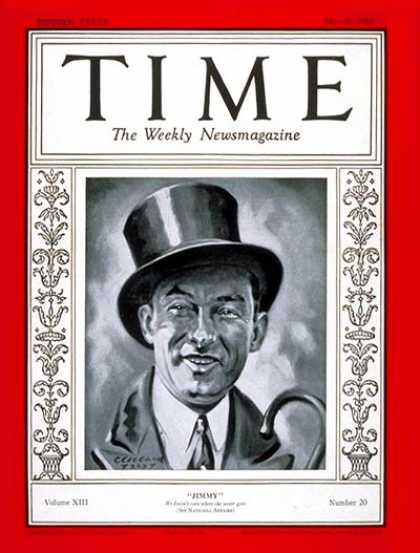
James J. Walker: will they still love him?

Walker on the cover of Time. Image from coverbrowser.com.

Despite being targeted by an investigative commission that had been uncovering corruption in New York City for years, mayor James J. Walker was nonplussed when he was finally called to court to give some answers in 1932. There were even flowers spread on his path into the courthouse, certainly an unusual display for a public official accused of graft. A roaring '20s dandy, Walker is a prime example of personality trumping political competence.

James John Joseph Walker was born in Greenwich Village, New York in 1881. He entered the New York Law School in 1902, but left three years later. Walker aspired to be a songwriter, and met with some success. In 1908, he wrote the lyrics for the hit song "Will You Love Me in December As You Do In May." When he failed to produce additional hits, Walker returned to law and was admitted to the bar in 1912.

Prior to that, in 1910, Walker was elected as a Democrat to the New York state assembly, with backing from the Democratic Party machine Tammany Hall. He served until 1914, and the next year he was elected to the state senate. He became the minority leader in 1921. As a state politician, Walker certainly solidified his popularity with the electorate by supporting measures to ease restrictions on sports and entertainment, including allowing movies and baseball games to take place on Sundays.

Most notably, he fathered a bill in 1920 to legalize professional boxing in New York. The legislation called for the major players in the sports, such as the fighters and referees, to be licensed. A state board of commissioners would have the power to revoke licenses if necessary. The sportswriter W.O. McGeehan encouraged passage of the bill, using something of an unfortunate example when he told Governor Al Smith that the sport was "conducted as honestly as American politics and I venture to say more honestly than the stock market." The bill was signed into law in May of 1920.

In 1925, Tammany and Smith backed Walker as their candidate for the mayor of New York City. The only catch was that a Democrat, John F. Hylan, had already been in office for two four-year terms. Not willing to go quietly, the introduction of Walker led to what Smith referred to as "a little family quarrel" but what was in fact quite a nasty bout of mudslinging. Smith said Hylan had a "blind subservience to a super-boss" and also accused him of secretly meeting with members of the Ku Klux Klan during the 1924 Democratic National Convention. Hylan shot back that Walker would allow thieves and prostitutes to run rampant in the Big Apple; he also described the party as a family, if something of a dysfunctional one. "The Governor has walked deliberately into our city and made trouble in a happy family," he declared. "A few grafting politicians, Wall Street, and the traction gang have tried to get your mayor by the throat, but I have stood like the Rock of Gibraltar running the city for the interests of all the people."

Hylan dropped out of the race in September, leaving Walker to face off against Republican candidate and fountain pen manufacturer Frank D. Waterman. Walker's platform included the advocacy of new highways, expansion of subway system, and maintenance of the subway's five-cent fare; Smith also stumped for him, touting Walker's work for housing, child welfare, soldier bonuses, and other issues. Perhaps more influential, Walker's support of entertainment initiatives earned him plaudits from movie stars, musicians, and sports fans. Irving Berlin wrote him a campaign song which featured the lyric "Win with Walker, he's a corker."

The campaign was also not without its dirty tricks, including one that left Waterman fending off accusations of anti-Semitism. Staffers sought to make a reservation at a hotel Waterman owned in Florida using the false name of Robinowitz. The hotel sent a written reply explaining, "Our clientele is such that the patronage of persons of Hebrew persuasion is not solicited." Walker easily won the general election.

Walker's inauguration in 1926 was notable for a few reasons. In the first of several incidents of tardiness that would earn him the nickname "The Late Mayor," Walker was one and a half hours late for the event. He was also the first mayor to have his inauguration speech broadcast by radio. When he abandoned the microphone to help a woman who had fainted in the crowd, many New Yorkers worried that the dead air signified that he had been assassinated.

Walker's tenure in office was marked by a lackadaisical attitude toward schedules and duties, and historians have offered the opinion that his legislative experience did not adequately prepare him for the administrative tasks of the mayor's office. He also earned the nickname "The Night Mayor" for his propensity to hit the night life, including a well-known but generally ignored affair with a showgirl named Betty Compton. In one incident, Walker is said to have been with Compton in a Montauk casino when the joint was raided by police, and managed to escape by running into the kitchen and disguising himself with a cook's outfit.

The two nicknames directly corresponded with one another. Time reported that Walker "seldom appears before noon, if at all." Sometimes he arrived hung over, and, suddenly a stickler for punctuality, would be short with visitors if they spent more than their allotted five minutes proposing a measure for the city. Needing a break from whatever work he did manage to do, Walker took seven vacations totaling 143 days during his first two years in office. In 1927, he traveled to Italy and personally met the country's dictator, Benito Mussolini.

Walker had made no promises to end the graft and proliferation of speakeasies that were thriving in Prohibition-era New York, the latter thanks in part to police officers willing to take payoffs to turn a blind eye to the establishments. The citizens of New York, if not the nation, seemed to take a similar attitude toward Walker's laziness and affair with Compton. When he went to Philadelphia in November of 1926 as part of a New York City delegation to the Sesquicentennial Exposition, crowds there declared him "our next President."

Walker was known for having an easygoing charm that was able to boost the adulations. His sayings included, "A reformer is a guy who rides through a sewer in a glass-bottomed boat" and "I'd rather be a lamppost in New York than mayor of Chicago." When the Republican candidate Fiorello La Guardia challenged him in 1929, he made the accusation that the city's judges were corrupt and the District Attorney, Thomas Crain, was a dolt. He also criticized the mayor's decision earlier that same year to boost his salary from $25,000 to $40,000. "That's cheap!" Walker responded. "Think what it would cost if I worked full time!" Walker won re-election.

Walker's turn in court was still several years away, but the events that would lead to that event began a month after the election. Then, magistrate Albert Vitale was honored at a dinner attended by judges, city officials, and mobsters. The event did nothing to help Vitale, as he had already admitted to taking a $19,500 loan from mobster Arnold Rothstein, who was murdered in November of 1928. It helped spur the formation of an investigative committee, headed by Samuel Seabury, an anti-Tammany Democrat and unsuccessful candidate for the 1916 gubernatorial election.

The investigation focused on the legitimacy of 50 magistrates in Manhattan and the Bronx under the committee's jurisdiction. Seabury assembled a team of young lawyers who he felt would not be corrupted by Tammany Hall, and the commission heard from over 1,000 witnesses in 1930. Magistrates were questioned in private, and many resigned when asked if they would repeat their testimony publicly. One, George Ewald, paid Tammany $10,000 to get his seat. Others had been appointed in exchange for favors. "This evidence presents a situation which is a scandal and a disgrace, as well as a menace, to the City of New York," said Seabury. The investigation also targeted Crain for his practice of letting people charged with serious crimes plead to misdemeanors. The commission determined that Crain was merely incompetent, not corrupt.

Reverend John Haynes Holmes and Rabbi Stephen S. Wise, acting on behalf of the City Affairs Committee, charged Walker with ignoring corruption, appointing incompetent officials, and poor administration of the city government. Walker's own response to the assessment was that the City Affairs Committee was subject to Socialist influences. Governor Franklin D. Roosevelt, hoping to secure Tammany backing for his own political ambitions, was at first reluctant to take on corruption in the city and declared that there wasn't enough evidence to remove Walker. However, when the Republican-controlled legislature called for an investigation into the city administration in March of 1931, Roosevelt approved $250,000 for a committee. Seabury joined the effort again as counsel.

The most disturbing aspect of the city government uncovered by the investigation was the outright framing of innocent people by the police department's vice squad. Most of the victims were women accused of prostitution. It was made clear to them that their options were to go to jail or fork over enough cash for their freedom. Other officials were found to have amassed much more money than they should have. Sheriff Tom Farley resigned after it was found that he had accumulated $400,000 after six years in an $8,000-a-year job. Russell T. Sherwood, a financial agent who shared a lockbox with the mayor, fled the city after he was subpoenaed to explain how he had made $700,000 after serving five years with a $10,000 annual salary.

When Seabury looked into the mayors financial records, he declared Walker's letters of credit "the fatal blow to Tammany Hall." He discovered that politicians and businessmen in the city had maintained a slush fund for Walker in exchange for favors, and that the club kept Walker's name off the record by referring to him as the "boyfriend." On one occasion, publisher Paul Block opened a Wall Street brokerage account with Walker, earning the mayor $246,692.72 even though the mayor never invested any money in it. On another, he received $26,535 in bonds from a stock broker interested in taxicab securities. John A. Hastings, a Democratic state senator and one organizer of the Equitable Coach Company, paid for one of Walker's vacations while aiming to gain control of the city's bus routes. Walker was also found to have accepted other gifts, such as the renovation of his childhood home on St. Luke's Place and a railroad car.

When Walker was summoned to court to answer questions about the finances, his popularity was still going strong. Time opined that his admirers "really would not care if it were proved that 'Jimmy' had stolen the Brooklyn Bridge." Walker's charm might have kept the galleries wooed, but it didn't work on Seabury; in fact, he had been warned against looking directly into Walker's eyes to help escape whatever wiles the mayor would employ. Seabury resolutely kept up the questions about the shady financial dealings in the city, and Walker's confidence slipped. Not long after the proceedings, he was booed at a baseball game at Yankee Stadium.

Seabury recommended to Roosevelt, by now the Democratic nominee for the 1932 Presidential election, that Walker was unfit for office. Walker sent his own defense to Roosevelt in the form of a 27,000 word letter in which he said the prosecution was politically motivated. "I have lived my life in the open. Whatever shortcomings I have are known to everyone--but disloyalty to my native city, official dishonesty or corruption, form no part of these short-comings," he said. It was also reported that Walker would seek the Democratic nomination for Governor if he were to be ousted. Ultimately, Walker unsuccessfully tried to get a court injunction in his favor and resigned from office on September 1, 1932, with a single sentence: "I hereby resign as Mayor of the City of New York, said resignation to take effect immediately."

Not long after his resignation, Walker took off for Europe with Betty Compton, whom he would later marry. Another Tammany man, John P. O'Brien, took his place, but the Seabury commission essentially marked the death blow for the political machine. In 1934, La Guardia was elected mayor with backing from Roosevelt, and the city slipped from Tammany's grasp. Roosevelt's New Deal program further weakened the institution, making people less dependent on Tammany for jobs. The machine had something of a recovery in the 1950s, but ultimately faded out of existence in the 1960s.

Walker's flight was a handy way of taking another European expedition while letting the controversy and his own tax status return to manageable levels. He returned to New York in 1935, doing law work and hosting a short-lived radio program. In 1937, he got a job as an attorney with the city's Transit Commission to prosecute grade crossing infractions. Seabury also happened to be on the commission as a judge, and suggested that Walker be on the payroll for 60 days before claiming a pension, saying it was not to be used as a "refuge from disgrace."

The next year, Walker visited FDR in the White House. In 1940, La Guardia named him labor arbitrator of the Manhattan garment industry. He continued his devotion to boxing by regularly speaking at the annual dinners of the Boxing Writers Association; he received the Edward J. Neil Memorial Award for Outstanding Contributions to Boxing, and in 1940 received another award for his years of service to the sport. Following his death, the award would be named after him.

Walker also briefly returned to the musical world, becoming president of Majestic Records in 1945. The next year, he died of a cerebral hemorrhage. Ultimately, he remained a popular figure. A movie about his life starring Bob Hope was produced, and in 1992 he was inducted into the International Boxing Hall of Fame.

Sources: The New York State Supreme Court Appellate Division, The National Parks Service, The Political Graveyard, "Paints Hylan Klan Servant" in the Evening Independent on Aug. 28 1925, "Word Battle Grows Hotter" in the Evening Independent on Aug. 31 1925, "Hylan May Run On Independent Ticket" in the Evening Independent on Sept. 16 1925, "Hylan Won't Run" in the New York Times on Sept. 30 1925, "Hail Mayor Walker As 'Next President'" in the New York Times on Nov. 13 1926, "Again, Walker" in Time on Mar. 5 1928, "Subway Jam" in Time on May 14 1928, "His Honor's Honor" in Time on Jun. 6 1932, "New York's Mayor Assails Accusers" in the Evening Independent on Jul. 29 1932, "Walker, If Removed, To Run For Governor" in the New York Times on Aug. 1 1932, "Walker Again" in Time on Aug. 30 1937, "Jimmy Walker, Tsar" in Time on Sept. 16 1940, "Former Mayor To Head Majestic Records" in the Christian Science Monitor on Feb. 16 1945, "The Late Mayor" in Time on Nov. 25 1946, A Flame of Pure Fire: Jack Dempsey and the Roaring '20s by Roger Kahn, The Boxing Register: International Boxing Hall of Fame Official Record Book by James B. Roberts and Alexander G. Skutt, New World Coming: the 1920s and the Making of Modern America by Nathan Miller, Big Town, Big Time: A New York Epic edited by Jay Maeder, The Epic of New York City: A Narrative History by Edward Robb Ellis, Franklin Delano Roosevelt: Champion of Freedom by Conrad Black, Mackerals in the Moonlight: Four Corrupt American Mayors by Gerald Leinwand

Tuesday, July 14, 2009

John W. Dawson: shovel-ready governor

Image from saltlakemagazine.com

As John W. Dawson told it, his stagecoach was at its first stop on a cross-country journey on New Year's Eve of 1861 when he found that several items of clothing had been taken. While waiting in the coach for the return of his physician, the driver made insulting remarks to him and Dawson chose to take his leave. As he was walking to a nearby house, the former Governor of the Utah Territory was attacked and beaten by the driver and other ruffians, an incident that punctuated Dawson's disgraced exit from the land.

Dawson was born in 1820 in Cambridge, Indiana. He worked as an office clerk and studied at Wabash College and Transylvania College. Further working as a lawyer and farmer, he eventually settled into the position of editor of the Fort Wayne Times and Union. Through the newspaper, Dawson supported public schools and temperance and criticized Catholics and abolitionists. He was especially vehement in this latter attitude when the Civil War broke out, saying the abolitionist movement only gave advocates of the Confederacy arguments to use in support of secession. Dawson's basic argument was that the preservation of the Union was a more important goal than the abolition of slavery. He asked if William Lloyd Garrison, a New England newspaper editor and prominent abolitionist, if he would admit "that this war is not a Godsend war for the abolition of negro slavery, but to maintain the supremacy of the Union and the Constitution, and that you will henceforth be silent on the wrongs of the slave and the atrocities of slaveholders, until throughout all the land the federal laws are freely obeyed?"

Like his working career, Dawson dabbled in a variety of political parties in a series of unsuccessful bids for public office. In 1854, he ran for the state house of representatives on the People's Party ticket. Two years later, he was back on the ballot running for Indiana secretary of state. This time, he was on a fusion ticket supported by the Republican and Know-Nothing parties. In 1858, he ran for the House of Representatives as a Democrat. In the election of 1860, however, he backed Abraham Lincoln, the Republican candidate, in his paper.

Given his relative lack of political experience, it is unclear how Dawson got the nod to be Governor of the Utah Territory. Some have suggested that he was a man of loose morals and an embarrassment to the Republican leaders in Indiana, and the distant desert territory seemed to be a proper point of exile. The post was also not the most popular one up for grabs, and Dawson's willingness to serve probably played in his favor. After Governor Alfred Cummings chose not to seek re-appointment, Lincoln appointed Dawson as the third Governor of the Utah Territory on October 3, 1861.

Dawson did not arrive in the territory until December 7, and took the oath of office on the 10th. It didn't take long for him to irk the predominantly Mormon population. In his first address to the territorial legislature, he urged them to pay a $26,982 annual tax to support Union war efforts. Doing so, he explained, would show that the Mormons were supportive of the country, not disloyal as had been alleged.

On December 17 and 18, the legislature passed a bill calling for a convention of delegates to create a constitution and organize a state government. Territorial secretary Frank Fuller of New Hampshire, who had served as acting Governor while waiting for Dawson to arrive, had already given his support for the measure. Dawson, however, vetoed it. He said the proposed date of the convention (January 6, 1862) was too close to submit the bill to Congress or notify the people of the territory. He also said the bill sought to fix the state's boundaries, which Congress would have to do. The rejection of the bill again did nothing to endear Dawson to the population.

On New Year's Eve, having served less than a month, Dawson suddenly packed up and began a journey back east. He left Fuller to take over the Governor's duties. A variety of reasons were given for Dawson's departure. Fuller said he had received a note saying Dawson was leaving for health reasons. The Deseret News said Dawson was leaving "under circumstances somewhat novel and puzzling," and alleged that the Governor had gone "distressingly insane."

The newspaper also mentioned the more prevalent theory behind Dawson's hasty retreat. He was accused of making indecent proposals to Albina Williams, his housekeeper and a Mormon widow in Salt Lake City. As the story went, Williams was so offended that she chased Dawson out of her house with a fireplace shovel. Dawson was also accused of trying to pay Williams $3,000 to keep quiet about the incident, and threatening to shoot Mormon newspaper editor Thomas B.H. Stenhouse if he published anything on the matter.

Stenhouse may have been sufficiently intimidated, though he also later left the church; in an account published in 1873, he said Dawson "was almost immediately a victim of misplaced confidence, and fell into a snare laid for his feet by some of his brother-officials." Catherine Van Valkenburg Waite, writing in 1867, also took this point of view. She argued that the incident was entirely fabricated as a way of expelling Dawson, since he was not as lenient toward Mormon leader Brigham Young as his predecessor. John Hanson Beadle, editor of the Salt Lake Reporter, also implied that the charges may have been false but clearly had no sympathy for Dawson. In an anti-Mormon book he wrote in 1870, Beadle said Dawson's later beating was "richly deserved for his cowardice, and, if the charge above be true, for his detestably bad taste."

Whatever the case, Dawson was fearful enough of assault that he took a hired guard to accompany him out of the territory. According to a statement Dawson later wrote for the Deseret News, he was told by Ephraim Hanks, station master at the first mail stop on the route, that some people might intend to rob or assault him. Dawson asked Hanks to accompany him, but Hanks said he was unable to and sent a man named Moroni Clawson to act as protection. Dawson said he gave Clawson five dollars for his troubles.

After the stagecoach stopped at Hanks' mail station at Mountain Dell, Dawson said, the crowd at the stopping point had supper and proceeded to get drunk and rowdy. When he checked on the coach, he found that it had been relieved of several blankets and "an elegant beaver robe." It was after this discovery that Dawson said the driver, apparently a relative of the scorned woman, began insulting him. Dawson insisted he had not provoked the men who attacked him after he exited the coach. In the statement to the Deseret News, he identified seven men who attacked him, including Clawson ("the traitor") and other men who had been hired to protect him.

According to one account, Dawson's injuries were "nearly emasculating," leading to rumors that he had been castrated as well as beaten. Dawson was quick to use the attack to characterize the Mormons as a lawless and detestable bunch. In a letter to Lincoln, he accused the population of disloyalty and said their push for statehood was only an effort to remove federal authorities from the territory and give polygamy "sovereign protection." He added, "The horrid crimes that have been committed in this territory & which have gone unpunished, have no parallel among civilized nations." Young, meanwhile, continued to push for statehood, saying the goal was "to no more endure the imposition of such men as...Governor Dawson." Though the convention seeking to create the state of Deseret went forward, Utah would not be admitted as a state until 1896.

Though they were no fans of Dawson, the Mormons did not want the attack to further inflame public opinion against them. Of the seven identified by Dawson, three were shot dead while trying to escape from police. Lot Huntington was killed on January 16, 1862. Clawson and a man named John P. Smith were killed the next day. The other attackers were captured and brought to justice.

In an interesting side note, the attack on Dawson indirectly led to the capture of an infamous grave robber. After Clawson was killed, he was buried in a Salt Lake City cemetery after his body was not initially claimed. When his family asked that Clawson be exhumed to be relocated to a family cemetery, they found that Clawson had been stripped of his clothes. The investigation found that a gravedigger, John Baptiste, had collected clothes, shoes, and personal effects from some 300 grave robberies. Baptiste was ultimately isolated on Fremont Island on the Great Salt Lake, but disappeared later in 1862, never to be seen again.

Dawson returned to find that the Senate had ultimately rejected his appointment, apparently based on the allegations that had come up against him. The incident also made Dawson quite unpopular in his home state, if he had ever garnered much favor to begin with. "He is a poor, despised, and hated ruffian, without a solitary friend of any influence on earth, outside of his own printing office," one letter to the People's Press of Bluffton, Indiana, declared. "This is not the first time that the community has been sickened and disgusted with the infamy and crime of John Dawson."

Not much is known of Dawson's post-gubernatorial activities. Most notably, he helped elevate the legend of Johnny Appleseed by writing the first accounts about him in 1871. Dawson had met the John Chapman, the person the legend is based on, when he was younger. In 1877, Dawson passed away in Indiana.

Sources: Utah History To Go, "The Governor of Utah Territory: A Significant Sign" in The Democratic Watchman on Nov. 21 1861, "Executive Communications" in the Deseret News on Dec. 25 1861, "Governor Dawson's Statement" in the Deseret News on Jan. 22 1862, "What The Public Journals Say About John W. Dawson" in the Deseret News on Feb. 26 1862, "Scandals, Shame, & Skeletons In The Closet" in Salt Lake Magazine in April 2009, It Happened In Utah by Gayen and Tom Wharton, Church Chronology: A Record Pertaining to the History of the Church of Jesus Christ of Latter-day Saints by Andrew Jenson, Improvement Era edited by Joseph F. Smith and Edward H. Anderson, Popular History of Utah by Orson F. Whitney, Abraham Lincoln and the Western Territories edited by Ralph Y. McGinnis and Calvin N. Smith, The Story of the Mormons: From the Date of their Origin to the Year 1901 by William Alexander Linn, The Rocky Mountain Saints: A Full and Complete History of the Mormons by Thomas B.H. Stenhouse, Life in Utah; or, The Mysteries and Crimes of Mormonism by John Hanson Beadle, The Saints and the Union: Utah Territory during the Civil War by Everette Beach Long, The Mormon Prophet and His Harem by Catherine Van Valkenburg Waite

Sunday, July 5, 2009

Wayne L. Hays: money for nothing

Elizabeth Ray and Wayne Hays. Image from Jet.

In April of 1976, Wayne Levere Hays was preparing for a second marriage and holding a wedding reception in the House Administration offices. The 14-term Ohio congressman had invited his staff to the ceremonies, with the exception of a buxom 33-year-old blonde named Elizabeth Ray. When she showed up anyway, Hays got into a heated argument with her and summoned the Capitol Police to escort Ray from the building. Hays' blunt attempt at damage control ultimately did more harm than good; immediately after the incident, Ray went to a phone booth and placed a call that kicked off a series of events leading to Hays' resignation.

Hays was born in Bannock, Ohio in 1911 and graduated from the Ohio State University at Columbus in 1933. He taught in the cities of Flushing and Findlay in his home state between 1934 and 1938 while also doing agricultural work on the side. His first political appointment came in 1939, when he was elected mayor of Flushing; according to his congressional profile, he held the post until 1945, though the profile also mentions that he served in the state senate in 1941 and 1942. Hays became a member of the U.S. Army reserve corps in 1933, and was called to active duty the day after Pearl Harbor was bombed in 1941. He served until the next year, when he received a medical discharge. From 1945 to 1949, he was a commissioner of Belmont County.

In 1948, Hays was elected to the House of Representatives as a Democrat, and managed to keep the seat for the next 28 years. During his time in Congress, he chaired a House delegation to the NATO Parliamentarians Conference and was president of the conference in 1956 and 1967. From 1969 to 1970, he was president of the North Atlantic Assembly.

Hays' first notable actions were his open mockery of a special House committee on which he served in 1954. The so-called Reece Committee, named for chairman Brazilla Carroll Reece (a Tennessee Republican), was formed to investigate several tax-exempt organizations for ties to Socialist or Communist movements. Included in the discussions was the research of human sexuality by Alfred Kinsey, which had been partially funded by the Rockefeller Institute. The committee soon drew criticism for its selective use of witnesses, as nine of the 10 witnesses that were ultimately called were employees of the committee.

On one occasion, Hays led a Democratic walkout from the committee, saying San Francisco lawyer Aaron Sargent had accused Democratic Senator Paul Douglas of Socialist ties; for good measure, Hays threatened to punch out a man who heckled him during the exit. In a ruse to demonstrate that statements were being taken out of context, Hays asked the committee's assistant research director, Thomas McNiece, for his opinion on three quotes advocating fair wages and relief for the poor. When McNiece said the quotes were consistent with Communist literature he had encountered, Hays retorted that they had actually been taken from the Encyclical of Pope Pius IX.

Ultimately, the committee fell apart after eight weeks when Reece declared that the hearings would end and the tax-exempt organizations could submit written statements to the congressional inquiries instead. Reece said both that Hays' actions had obstructed the committee and that the written statements would expedite the process. Hays' own opinion was that the witness testimony "was so utterly nonsensical and without basis in fact that it fell of its own weight, it seems to me that the action taken today was the least embarrassing way that Mr. Reece and his staff could get offstage.''

Over the years, Hays gained a reputation for his temper; Democratic Congressman Phillip Burton of California described him as "the meanest man in Congress." Periodically, Hays appeared in the news for some incident where these characteristics were at play. In 1956, Hays said he'd heard that the U.S. Immigration Commissioner, Joseph M. Swing, might inhibit his efforts to get citizenship for his adopted daughter and said Swing "will not be able to physically hold the job from then on" if that happened; Swing was defended by New Jersey congressman Alfred Sieminski, who suggested that he and Hays take it outside. In 1966, Hays was cited for speeding, unsafe operation, and failure to comply with the lawful order of a police officer after driving away from a traffic stop. Hays said he was offended by the cop, who had patted his holstered pistol while they talked, so he simply took off and refused to pull over again until the officer gave up the chase.

Most notably, Hays was criticized in 1963 for taking the head waiter of the House of Representatives, Ernest Petinaud, to London and Paris with a congressional delegation that he headed. Petinaud's transportation, room and board, and other expenses were paid for by the government. Hays said that the waiter served as a messenger during the trip; he also said Petinaud was invited in part because he was black, and also because he was a nice person who deserved a break.

Hays had a feud with Democratic Congressman Adam Clayton Powell, Jr. of New York going back to at least 1956. In that year, Powell supported Dwight Eisenhower for President because he preferred Eisenhower's stance on racial integration. Hays requested that the Democratic caucus strip Powell of his committee assignments, and headed the 1966 probe into Powell's possible misuse of funds for travel. As has been noted, Powell replied in his autobiography that Hays' junket with Petinaud made him guilty of the same impropriety.

Following the 1970 elections, Hays became chairman of the Committee on House Administration and the Joint Committees on Printing and the Library. The House Administration committee controlled such functions as travel vouchers, office expenses, committee budgets, and other matters related to the House. He also chaired the Democratic Congressional Campaign Committee, which distributed campaign funds to House members and candidates.

Hays was accused of using his power on the House Administration committee to bully other congressmen and House employees. Among his orders were the removal of jump seats from the elevators so the operators would have to stand and banning tips for House barbers. After the 1974 elections, a reform effort aimed to remove Hays from this position, but he retained the chairmanship in a 161-111 vote. Meanwhile, in January of 1976, Ohio secretary of state Ted Brown accused Hays of abusing the congressional privilege of free mailing by sending out 160,000 letters to constituents opposing four state bond issues.

Hays was popular enough in his home district that there were rumors that he would seek a higher office, namely the Democratic nomination for the 1976 presidential race, or perhaps enter the Ohio gubernatorial race in 1978. He supported the public financing of presidential races, but not congressional ones, arguing that such regulation would lead to a glut of candidates. He helped craft a campaign finance reform act along these lines in 1974.

There were hints of Hays' possible infidelity prior to the incident in April of 1976. Earlier in the year, Hays divorced his wife, Martha, to whom he had been married for 38 years. His second marriage occurred quite close to the termination of his first, and to a woman some 30 years younger than him: Patricia Peak, the personal secretary in his Ohio office. Five weeks after the marriage, the scandal broke.

Elizabeth Ray had previously had a chance encounter with Marion Clark, a Washington Post reporter, on a train that had been delayed by a paint factory explosion. As the passengers swapped stories, Ray said that she had had quite a few sexual escapades in the nation's capital, including with congressmen. Clark tried to keep in touch with Ray, but lost track when Ray briefly went west to try to make it as an actress. Ray remembered Clark, however, and was eager to spill the beans on Hays after she was thrown out of his office.

Ray said that she had been working on Capitol Hill since 1972, starting as a hostess and then working for a few congressmen. She began working for Hays in April of 1974 as a clerk for the House Administration Committee. As Ray told it, though, "work" was too strong a term for what she did. Basically, she told the reporters, she was a hired mistress, coming in only a few hours per week to have sex with Hays and receiving $14,000 a year for the administrative duties she never performed. "I can't type. I can't file. I can't even answer the phone," she said.

Ray said she knew of other girls working for congressmen who also had to submit to sex to keep their jobs, and made references to "orgies" at the Capitol attended by congressmen. She said that on one occasion, Hays referred to the Fanne Fox incident by saying that any woman that embarrassed him in such a way would be "six feet under."

Clark and Post reporter Rudy Maxa took Ray up on the story and personally witnessed her dinner dates with Hays on a couple of occasions. Ray also allowed them to eavesdrop on a phone call from Hays. When Ray asked what the state of their relationship would be after Hays' wedding, Hays replied, "If you behave yourself, we'll see." He also advised her to start coming into work more often, since he was afraid that Bob Woodward, one of the two Post reporters who had managed to crack open the Watergate scandal, was after him (Woodward was looking into Hays on restaurant expenses, but not the Ray affair). Ray asked, "Do I still have to screw you?" Hays answered, "Well, that never mattered."

The Post ran the story on May 23, 1976. It included Hays response to the question of whether he had been having an affair: "Hell's fire! I'm a very happily married man!" However, the personal witness accounts of the reporters, including a transcription of the phone call, made the denial ring hollow. The story also accused another committee staffer, Paul Panzarella, of living with Hays' niece and receiving a paycheck for doing virtually no work. In later investigations, Hays was accused of giving two other men annual salaries of $25,000 and $10,000 for minimal contributions to the committee.

Two days after his denial, Hays admitted to having a "personal relationship" with Ray but maintained that she had done work for the committee and had not been hired solely for sex. Time opined that Ray was not the most sympathetic character, described by past boyfriends as "nutty, spacey, neurotic, or dim," but that Hays' overall crustiness made him a particularly worthy subject to be knocked down a peg or two. In July of 1976, the Ohio Black Political Assembly called for Hays' expulsion, saying the House had set a precedent for expulsion for misconduct with the Powell decision and needed to be consistent. Noting that Powell, dead since 1972, had said he could come back to haunt those who had removed him because they were guilty of the same sins, a lawyer later referred to Ray as "the ghost of Adam Clayton Powell."

In June, Hays was hospitalized after taking an overdose of sleeping pills, an action he insisted was accidental and not a suicide attempt. The same month, he resigned from the Democratic Congressional Campaign Committee and Committee on House Administration, an action that automatically removed him as chair of the Joint Committee on Printing. He said he was resigning due to the accusations and the state of his health, but that he was convinced he would be exonerated and possibly restored. In fact, Hays was easily able to win the Democratic nomination for the 1976 election that month.

Instead of proceeding, Hays announced in August that he would not seek re-election. "The polls show I'd win, but I don't want to give that woman another chance to make an appearance," he said. By this point, a book on the affair entitled "The Washington Fringe Benefit" had been published under Ray's name. Ray herself said she regretted her actions and that she had not intended to bring about Hays' downfall; she even declared, "He's suffered enough. He's gone through enough torture."

On September 1, Hays resigned. The House Committee on Standards of Official Conduct immediately dropped its investigation, since they no longer had jurisdiction in the matter. Hays had reportedly asked for the ethics committee to look into the matter in order to show that Ray had actually worked for her salary, though other sources say the resignation was explicitly to escape the committee's investigation.

The matter was not a simple matter of infidelity, however; there was still the question of whether Hays had thrown away government money on useless employees. For a time, the Justice Department looked into whether Hays could be charged with conspiracy to defraud the government or conversion of public funds to private use. In October, three lawsuits seeking to recover Ray's salary were dismissed, and in December the Justice Department closed their investigation without pressing charges. An anonymous source said there was a lack of evidence against Hays, and that Ray's credibility was also an issue.

Douglas Applegate, the Ohio state senator chosen to replace Hays as the Democratic nominee, won the 1976 election and served until his decision to not run for re-election in 1994. Hays' marriage survived the uproar and he returned to his farm in Ohio, where he raised cattle and horses. Only two years after the scandal, he ran for the state house of representatives; his Republican opponent, George Contos, tried to use the scandal against Hays but without success. Hays served one term before being defeated in a re-election attempt. In 1980, he became chairman of the Belmont County Democratic Party, and the next year he was elected to the Belmont County Board of Education. In 1989, he died at a hospital in Wheeling, West Virginia after suffering a heart attack.

Sources: The Biographical Directory of the United States Congress, "McArthur Inquiry Sought In Capital" in the Toledo Blade on Jun. 25 1949, "Democrats Walk Out of House Probe" in the Pittsburgh Post-Gazette on May 25 1954, "The Lesson" in Time on Jun. 21 1954, "Report Card" in Time on Jul. 12 1954, "Work Done" in Time on Apr. 2 1956, "Ohio Congressman Walks Out of Ike's Middle East Huddle" in the Daily Collegian on Jan. 9 1957, "Hays, Headwaiter Return" in the Toledo Blade on Nov. 12 1963, "Ohio Mayor Says Lawmaker To Find Law Is Not A Joke" in the Toledo Blade on Feb. 20 1966, "Powell Acts May Bring Prosecution" in the Eugene Register-Guard on Dec. 22 1966, "Patman Pushed Out As Panel Chairman" in the Pittsburgh Post-Gazette on Jan. 23 1975, "Hays Is Charged With Misuse of Mail Privilege" in the Bryan Times on Jan. 5 1976, "Milestones" in Time on Apr. 26 1976, "Closed Session Romance On The Hill" in the Washington Post on May 23 1976, "Indecent Exposure On Capitol Hill" in Time on Jun. 7 1976, "Hays' Resignation Accepted" in the Ellensburg Daily Record on Jun. 21 1976, "How The Washington Post Got The Goods On Wayne Hays" in New York Magazine on Jun. 21 1976, "Liz Ray Could Be 'Adam Powell's Ghost:' Lawyer" in Jet on Jul. 15 1976, "Black Group Wants Hays Expelled" in the Bryan Times on Jul. 27 1976, "Study Reveals Third Marginal Hays' Staffer" in The Ledger on Aug. 5 1976, "Hays Quits Race, Hopes That Finishes Miss Ray" in the Eugene Register-Guard on Aug. 13 1976, "Wayne Hays Is Replaced" in the Spokane Daily Chronicle on Aug. 17 1976, "One Incumbent Loses" in the Bryan Times on Nov. 8 1976, "Elizabeth Ray" in the Boca Raton News on Sept. 1 1976, "Hays Resigns House Seat" in the Spokesman-Review on Sept. 2 1976, "Capitol Hill's Sex Scandal All Worn Out" in the Eugene Register-Guard on Dec. 9 1976, "Scandal Ads Backfire in Hays' Ohio Contest" in the Pittsburgh Post-Gazette on Oct. 21 1978, "Wayne Hays Elected To Ohio School Post" in the Spokesman-Review on Nov. 3 1981, "Wayne L. Hays of Ohio Dies at 77" in the New York Times on Feb. 11 1989, Ohio Politics by Alexander P. Lamis and Mary Anne Sharkey, The Betrayal of the American Right by Murray N. Rothbard and Thomas E. Woods, Philanthropic Foundations In The Twentieth Century by Joseph Charles Kiger, Encyclopedia of White-Collar and Corporate Crime by Lawrence M. Salinger

Thursday, July 2, 2009

Page Morris: hit and run

Image Unavailable

Robert Page Walter Morris, more commonly known as either Page Morris or Robert P. Morris, might well be the least scandalous figure to appear on this blog so far. With a long career as a teacher, lawyer, congressman, and judge, Morris was never implicated in any crime or official misconduct. However, his position did earn him more attention for an incident later in his life than he would have otherwise received.

Morris was born in Lynchburg, Virginia in 1853. He attended the College of William and Mary and graduated from the Virginia Military Institute in 1872. He stayed at the school to become an assistant professor of mathematics for a year, then moved on to teach mathematics at the Texas Military Institute from 1873 to 1876. Morris also became a professor of applied mathematics at the Agricultural and Mechanical College of Texas from 1876 to 1879.

At some point, Morris turned his attention to law, and he was admitted to the bar in 1880. He returned to his hometown to open a private practice. Morris made his first attempt at office in 1884, running for the House of Representatives in 1884 as a Republican, but was unsuccessful. He moved to Duluth, Minnesota, in 1886 and three years later became a municipal judge in that city. In 1894, he became city attorney, and in 1895 he was appointed district judge of Minnesota's 11th district. He resigned this position the next year, when he was elected to the House of Representatives.

Morris won the next two elections as well before declining to run for renomination in 1902. His most notable achievement came in his last term, when he introduced a bill that came to be known as the Morris Bill. The Nelson Act of 1889 had sought to relocate Indians living in Minnesota and take control of the vacated lands. By the turn of the century, the Chippewa Indians had ceded some three million acres to the federal government. However, the government had advanced more money than it had received from timber sales, and so the Indian treasury (overseen by the government) was in deficit. The main problem with the Nelson Act was that it allowed for widespread fraud to take place in the timber sales, thus reducing the amount of money that went into the government coffers.

The Morris Bill sought to prevent such fraud by having the government take on the supervision and logging responsibilities. It changed the measure of timber sales to the quantity after a cut, as opposed to the previous method where the timber was estimated and sold based on the stumps. The bill also had the pine sold by sealed rather than open bid, eliminated a section on dead and downed wood, and created a 225,000-acre forest reserve that was the basis for the Chippewa National Forest. The bill was passed into law in 1902, and one estimate said two to three times as much money would go toward the Indian treasury under the new system.

In February of 1903, one month after Morris left Congress, he was nominated by President Theodore Roosevelt to be U.S. District Court judge for Minnesota. The Senate confirmed the appointment the next month. Morris would hold the position for the next 20 years, occasionally handling cases that showed up on the national scene. In one, he sentenced a man who had sent a threatening letter to Roosevelt to a year in prison; the man said he had been under the influence of cocaine at the time.

Morris himself became the subject of the news in October of 1921. The New York Times reported that he had been sitting in Salt Lake City, Utah around that time; however, he had made his way over to California for some reason. There, in Pasadena, Morris accidentally struck a pedestrian named Elizabeth Holmes with his vehicle. Luckily, Holmes was only slightly injured, but Morris only stopped after motorcycle officers had given chase for seven blocks.

Morris was arrested for failing to stop and render assistance to Holmes, and pleaded not guilty to a charge of reckless driving. A trial was set for November, but Holmes ultimately admitted to a reduced charge of failing to give a traffic signal. He avoided jail and paid a $10 fine.

The accident did not affect Morris's appointment as federal judge, but by April of 1922 he had announced that he would be retiring. He did so in 1923, relocating to Pasadena. In 1924, he died in Rochester, Minnesota.

Sources: The Biographical Directory of the United States Congress, The Federal Judicial Center, "A Year For Threatening Roosevelt" in the New York Times on Apr. 7 1905, "Federal Judge Arrested" in the New York Times on Oct. 21 1921, "Accuses Judge of Reckless Driving" in the New York Times on Oct. 22 1921, "Judge Fined in Minnesota" in the New York Times on Nov. 27 1921, Forestry and Irrigation for January 1906 by the American Forestry Association, Law Notes for April 1922 published by the Edward Thompson Company, The White Pine Industry in Minnesota: A History by Agnes M. Larson