Showing posts with label graft. Show all posts

Tuesday, February 23, 2010

Nehemiah G. Ordway: doubling Dakota

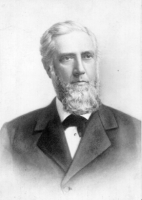
Image from history.nd.gov

The town of Yankton, South Dakota, is one of the southernmost communities in the state. Tucked away near the borders with Nebraska and Iowa, Yankton was also the capital of the Dakota Territory when it existed as one large entity. It was thanks in part to the actions of Nehemiah G. Ordway, a Governor of the territory, that the country has two Dakota states and Yankton has been left not as a state capital but only as the seat of a county bearing its name.

Under Ordway's administration, the territory was swollen with thousands of settlers. Between 1879 and 1884, the population more than doubled. The question wasn't if Dakota would be admitted into the Union, it was whether it would be admitted as a single state or two. The consensus seemed to be that Yankton was located too far south to adequately cater to the vast territory, especially with settlement occurring throughout. But it was also thought that the question of whether the capital should be moved would wait until it was decided how many states would be made out of Dakota.

So it was quite a surprise when Ordway, a single-state advocate, initiated the process for a capital move before the statehood question had been resolved. In 1883, he created a nine-member commission to study the feasibility of moving the government offices elsewhere. Even creating the commission was something of a task. There was enough opposition that Ordway only secured passage in the legislature by threatening to veto consideration of communities whose members did not support the study. Eventually, it came to pass that the requirements for the new capital were pretty basic: a parcel of land, $100,000, and a location more central to Dakota.

As in Idaho, the prospect of the capital leaving its original location was met with a great deal of hostility. In the Dakota case, however, the anger arose from the seemingly transparent graft involved in the effort. Three of the commission members were affiliated with the Northern Pacific Railroad, including Alexander McKenzie, a political agent of the railroad and sheriff of Bismarck. Ordway was further influenced by Henry Villard, the president of the railroad. As the removal process went forward, Bismarck was considered for the new capital, and it just so happened that the town was located right on the Northern Pacific line. Across the territory, newspapers and "indignation meetings" denounced the proceedings as corrupt, with one meeting in Sioux Falls vowing to ask the President or House of Representatives to get rid of Ordway. "Individually, we were in favor of removal of the capital," one newspaper said, "but wanted to see it done honestly and in the interest of the territory."

Twelve different towns made a bid for the capital, but the circumstances (and perhaps some bribery) had essentially determined that the capital would go to Bismarck. The town received the honor after offering $100,000 and 320 acres of land, a cash bid equal to the other towns but a land bid twice as large as most of them. At one point, a meeting had to take place in Yankton as part of the removal process, but citizens there managed to get a court order to prevent it. Ordway and the others involved in the process managed to subvert it by holding the meeting on a rail car passing through the town, achieving the necessary requirements while at the same time not quite violating the order. Ordway established the Capital National Bank in Bismarck and began overseeing the construction of a capitol building in Bismarck, as well as public buildings such as an insane asylum, universities, and schools. The territory's split was foreshadowed by the flat out refusal of some of the government offices to leave Yankton. The treasury and supreme court were among those that stayed, essentially dividing the duties of the territory between two different capitals.

Dakotans in the southern portion of the territory were so disgusted by the removal efforts that they created the Dakota Citizens League, and in September of 1883 they held a constitutional convention in Sioux Falls to create a document exclusively for a South Dakota. The constitution was approved, but only 40 percent of the territory's voters bothered to show up to do so. Congress was not impressed, and didn't approve it. Another attempt in 1885 was made, along with an unsuccessful effort to get the capital moved from Bismarck to the present day South Dakota capital of Pierre. The turnout was similarly light, but the House of Representatives passed the constitution. Afraid that two states would upset the congressional balance by inflating the Republican count, however, the Senate turned it down. Finally, in the 1888 elections, the Republican Party turned the Dakota statehood into a campaign issue. In February of 1889, Congress passed an enabling act and, after further revisions to the constitution, North and South Dakota were admitted into the Union in December. So in his questionable actions regarding the capital removal, Ordway had brought about a result he personally disfavored but his party supported.

As was the case in numerous western territories, the residents also took something of a dislike to Ordway because he'd been brought in from out of the area. Born in Warner, New Hampshire in November of 1828, he was elected sergeant of arms of the New Hampshire house of representatives in 1855. The next year, Ordway was returned to the position and earned another two appointments: assistant clerk to the house and high sheriff of Merrimac County, a position he held for five years. In 1857, he was named marshal and tax collector of Concord. He resigned the office in 1861 after he was appointed postal agent for the New England states. Ordway also pursued financial interests, establishing the Kearsage National and Savings Banks in his hometown.

He was commissioned as a colonel in 1862, and the next year he was elected sergeant of arms for the House of Representatives for the first time. He spent 12 years there, and served several terms in the New Hampshire legislature between 1875 and 1880. Finally, Ordway took part in a constitutional convention that established major changes to the state's tax system.

Ordway was appointed Governor of the Dakota Territory in 1880 by Republican President Rutherford B. Hayes. Recognizing that Dakota soil was well-suited for growing a diverse variety of crops, Ordway arranged for a rail car of the territory's agricultural products to tour the fairs and locales of the eastern states. He was also faced almost immediately with a crisis, as heavy snows during the winter of 1880 to 1881 led to a massive spring melt and devastating floods. Though he was out of the territory at the time, he sought to raise $100,000 to go toward the ongoing relief efforts. A hefty study entitled History of Dakota Territory was hardly charitable to Ordway, but conceded that he had done well in the appointment of W.H.H. Beadle as territorial superintendent of public instruction. In fact, the authors claimed they could find not one thing amiss with the administration of education in Dakota. They said that in 1884-1885 the territory was spending more on education than 22 states and had a schoolhouse for every 151 residents, a better proportion than 21 states.

The general consensus, unfortunately, was that Ordway was an easily corruptible Governor. He had gotten into office with the support of New Hampshire land speculators, and later gave one of his associates from that state the lucrative contract for a Sioux Falls penitentiary. He gave his son the well-paying position of territorial auditor. He spent a great deal of time outside of Dakota, acting as something of a representative to Washington even though that role was already taken by the territorial delegate to Congress. This delegate, John B. Raymond, refused to introduce a bill for single statehood because he had come to office promising division. In retaliation, Ordway and his supporters managed to get Raymond's nomination overturned at the Republican Territorial Convention. He was also criticized for vetoing dozens of bills for the construction of public buildings during the 1881 legislative session, but letting thousands of bills of questionable importance through in 1883.

By the time Ordway's appointment was coming to a close in May of 1884, petitions had started to pour into the White House begging Republican President Chester A. Arthur to give them a different Governor. Their wishes were soon met by a new, more solid controversy that erupted not long before Arthur had to make up his mind on the appointment. Under territorial law, counties could petition for organization after sending the signatures of fifty residents to the Governor; the Governor could then appoint commissioners. After that point, the commissioners would assume the appointment of county officials and other matters, including where to locate the county seat (a process the Governor was not supposed to have a role in).

Several accusations about shoddy practices in the process came to light. It became apparent that the organization of counties was largely corrupt, with people forced to give cash or land to influence the appointment of commissioners who would favor their town for the county seat. Ordway was said to have rescinded the appointment of a commissioner in Hyde County upon realizing that the man wouldn't fall in line in a vote on where to place the county seat. In another incident in Potter County in 1883, the commissioners for Potter County held a meeting about where the county seat would be located. One of the commissioners was shut out, and by the time he arrived he discovered that the seat and county officers had already been chosen. He immediately wrote to a judge, accusing one of the other commissioners of bribing Ordway to receive his appointment.

A federal investigation began, and Ordway was indicted for taking bribes to influence the appointment of commissioners in Faulk County. During the criminal proceedings, Ordway ceased to be Governor and Arthur removed him from office, naming Chicago writer Gilbert A. Pierce as the next Governor. United States Attorney Hugh Campbell sought to capture Ordway in a wide net of corrupt practices. He said the Governor had delayed the organization in Faulk County for about a year despite receiving petitions. At that point, an acquaintance of Ordway's had come to Dakota and approached the authorities in two towns hoping to receive the county seat. Both towns were told they could receive the seat if they were found to be favorable, and so they each raised land and funds for that goal. Eventually, LaFoon Townsite Company was chosen after giving half of their 440 acres and some cash to help Ordway make up his mind.

The defense employed a loophole, arguing that Ordway couldn't be punished in a criminal court because of his authority. The only punishment he could receive would be removal from office by the President, something that had already happened. The prosecution fired back that Ordway was the subject to the same criminal laws as everyone else and removal alone was insufficient. The judge agreed with Ordway's defenders, and the indictment was quashed. The acquittal did nothing to save Ordway's reputation. History of Dakota said it was unfortunate that a Governor such as Ordway was in office when such strides were being made by the territory's inhabitants. "He did little for Dakota except to stir up strife and spread abroad scandalous reports regarding the integrity of the people," the publication said.

Ordway returned east to take up business pursuits and agriculture, establishing an estate of 400 to 500 acres. He also joined his friends at the Northern Pacific Railroad, becoming a special agent with the company and leading their Washington lobby. Though it was reported that Ordway's health had been seriously impaired by his efforts in Dakota, the reports were exaggerated or he managed to recover. He survived until July of 1907, when he passed away in Boston.

Sources: The State Historical Society of North Dakota, "A Dakota Bribery Case" in the New York Times on Dec. 30 1883, History of Dakota Territory Vol. 2 by George Washington Kingsbury and George Martin Smith, North Dakota Magazine Vol. 2 Issue 2, The United States: Louisiana to Ohio by Benjamin F. Shearer, South Dakota: A Bicentennial History by John R. Milton, The WPA Guide to South Dakota, A Shovel of Stars: The Making of the American West 1800 to Present by Ted Morgan, Men of Progress by Richard Herndon

Wednesday, July 29, 2009

James J. Walker: will they still love him?

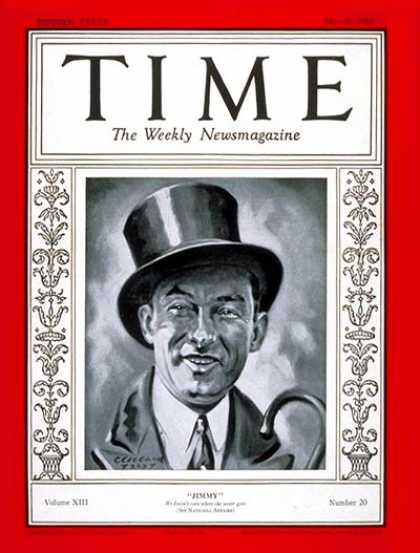
Walker on the cover of Time. Image from coverbrowser.com.

Despite being targeted by an investigative commission that had been uncovering corruption in New York City for years, mayor James J. Walker was nonplussed when he was finally called to court to give some answers in 1932. There were even flowers spread on his path into the courthouse, certainly an unusual display for a public official accused of graft. A roaring '20s dandy, Walker is a prime example of personality trumping political competence.

James John Joseph Walker was born in Greenwich Village, New York in 1881. He entered the New York Law School in 1902, but left three years later. Walker aspired to be a songwriter, and met with some success. In 1908, he wrote the lyrics for the hit song "Will You Love Me in December As You Do In May." When he failed to produce additional hits, Walker returned to law and was admitted to the bar in 1912.

Prior to that, in 1910, Walker was elected as a Democrat to the New York state assembly, with backing from the Democratic Party machine Tammany Hall. He served until 1914, and the next year he was elected to the state senate. He became the minority leader in 1921. As a state politician, Walker certainly solidified his popularity with the electorate by supporting measures to ease restrictions on sports and entertainment, including allowing movies and baseball games to take place on Sundays.

Most notably, he fathered a bill in 1920 to legalize professional boxing in New York. The legislation called for the major players in the sports, such as the fighters and referees, to be licensed. A state board of commissioners would have the power to revoke licenses if necessary. The sportswriter W.O. McGeehan encouraged passage of the bill, using something of an unfortunate example when he told Governor Al Smith that the sport was "conducted as honestly as American politics and I venture to say more honestly than the stock market." The bill was signed into law in May of 1920.

In 1925, Tammany and Smith backed Walker as their candidate for the mayor of New York City. The only catch was that a Democrat, John F. Hylan, had already been in office for two four-year terms. Not willing to go quietly, the introduction of Walker led to what Smith referred to as "a little family quarrel" but what was in fact quite a nasty bout of mudslinging. Smith said Hylan had a "blind subservience to a super-boss" and also accused him of secretly meeting with members of the Ku Klux Klan during the 1924 Democratic National Convention. Hylan shot back that Walker would allow thieves and prostitutes to run rampant in the Big Apple; he also described the party as a family, if something of a dysfunctional one. "The Governor has walked deliberately into our city and made trouble in a happy family," he declared. "A few grafting politicians, Wall Street, and the traction gang have tried to get your mayor by the throat, but I have stood like the Rock of Gibraltar running the city for the interests of all the people."

Hylan dropped out of the race in September, leaving Walker to face off against Republican candidate and fountain pen manufacturer Frank D. Waterman. Walker's platform included the advocacy of new highways, expansion of subway system, and maintenance of the subway's five-cent fare; Smith also stumped for him, touting Walker's work for housing, child welfare, soldier bonuses, and other issues. Perhaps more influential, Walker's support of entertainment initiatives earned him plaudits from movie stars, musicians, and sports fans. Irving Berlin wrote him a campaign song which featured the lyric "Win with Walker, he's a corker."

The campaign was also not without its dirty tricks, including one that left Waterman fending off accusations of anti-Semitism. Staffers sought to make a reservation at a hotel Waterman owned in Florida using the false name of Robinowitz. The hotel sent a written reply explaining, "Our clientele is such that the patronage of persons of Hebrew persuasion is not solicited." Walker easily won the general election.

Walker's inauguration in 1926 was notable for a few reasons. In the first of several incidents of tardiness that would earn him the nickname "The Late Mayor," Walker was one and a half hours late for the event. He was also the first mayor to have his inauguration speech broadcast by radio. When he abandoned the microphone to help a woman who had fainted in the crowd, many New Yorkers worried that the dead air signified that he had been assassinated.

Walker's tenure in office was marked by a lackadaisical attitude toward schedules and duties, and historians have offered the opinion that his legislative experience did not adequately prepare him for the administrative tasks of the mayor's office. He also earned the nickname "The Night Mayor" for his propensity to hit the night life, including a well-known but generally ignored affair with a showgirl named Betty Compton. In one incident, Walker is said to have been with Compton in a Montauk casino when the joint was raided by police, and managed to escape by running into the kitchen and disguising himself with a cook's outfit.

The two nicknames directly corresponded with one another. Time reported that Walker "seldom appears before noon, if at all." Sometimes he arrived hung over, and, suddenly a stickler for punctuality, would be short with visitors if they spent more than their allotted five minutes proposing a measure for the city. Needing a break from whatever work he did manage to do, Walker took seven vacations totaling 143 days during his first two years in office. In 1927, he traveled to Italy and personally met the country's dictator, Benito Mussolini.

Walker had made no promises to end the graft and proliferation of speakeasies that were thriving in Prohibition-era New York, the latter thanks in part to police officers willing to take payoffs to turn a blind eye to the establishments. The citizens of New York, if not the nation, seemed to take a similar attitude toward Walker's laziness and affair with Compton. When he went to Philadelphia in November of 1926 as part of a New York City delegation to the Sesquicentennial Exposition, crowds there declared him "our next President."

Walker was known for having an easygoing charm that was able to boost the adulations. His sayings included, "A reformer is a guy who rides through a sewer in a glass-bottomed boat" and "I'd rather be a lamppost in New York than mayor of Chicago." When the Republican candidate Fiorello La Guardia challenged him in 1929, he made the accusation that the city's judges were corrupt and the District Attorney, Thomas Crain, was a dolt. He also criticized the mayor's decision earlier that same year to boost his salary from $25,000 to $40,000. "That's cheap!" Walker responded. "Think what it would cost if I worked full time!" Walker won re-election.

Walker's turn in court was still several years away, but the events that would lead to that event began a month after the election. Then, magistrate Albert Vitale was honored at a dinner attended by judges, city officials, and mobsters. The event did nothing to help Vitale, as he had already admitted to taking a $19,500 loan from mobster Arnold Rothstein, who was murdered in November of 1928. It helped spur the formation of an investigative committee, headed by Samuel Seabury, an anti-Tammany Democrat and unsuccessful candidate for the 1916 gubernatorial election.

The investigation focused on the legitimacy of 50 magistrates in Manhattan and the Bronx under the committee's jurisdiction. Seabury assembled a team of young lawyers who he felt would not be corrupted by Tammany Hall, and the commission heard from over 1,000 witnesses in 1930. Magistrates were questioned in private, and many resigned when asked if they would repeat their testimony publicly. One, George Ewald, paid Tammany $10,000 to get his seat. Others had been appointed in exchange for favors. "This evidence presents a situation which is a scandal and a disgrace, as well as a menace, to the City of New York," said Seabury. The investigation also targeted Crain for his practice of letting people charged with serious crimes plead to misdemeanors. The commission determined that Crain was merely incompetent, not corrupt.

Reverend John Haynes Holmes and Rabbi Stephen S. Wise, acting on behalf of the City Affairs Committee, charged Walker with ignoring corruption, appointing incompetent officials, and poor administration of the city government. Walker's own response to the assessment was that the City Affairs Committee was subject to Socialist influences. Governor Franklin D. Roosevelt, hoping to secure Tammany backing for his own political ambitions, was at first reluctant to take on corruption in the city and declared that there wasn't enough evidence to remove Walker. However, when the Republican-controlled legislature called for an investigation into the city administration in March of 1931, Roosevelt approved $250,000 for a committee. Seabury joined the effort again as counsel.

The most disturbing aspect of the city government uncovered by the investigation was the outright framing of innocent people by the police department's vice squad. Most of the victims were women accused of prostitution. It was made clear to them that their options were to go to jail or fork over enough cash for their freedom. Other officials were found to have amassed much more money than they should have. Sheriff Tom Farley resigned after it was found that he had accumulated $400,000 after six years in an $8,000-a-year job. Russell T. Sherwood, a financial agent who shared a lockbox with the mayor, fled the city after he was subpoenaed to explain how he had made $700,000 after serving five years with a $10,000 annual salary.

When Seabury looked into the mayors financial records, he declared Walker's letters of credit "the fatal blow to Tammany Hall." He discovered that politicians and businessmen in the city had maintained a slush fund for Walker in exchange for favors, and that the club kept Walker's name off the record by referring to him as the "boyfriend." On one occasion, publisher Paul Block opened a Wall Street brokerage account with Walker, earning the mayor $246,692.72 even though the mayor never invested any money in it. On another, he received $26,535 in bonds from a stock broker interested in taxicab securities. John A. Hastings, a Democratic state senator and one organizer of the Equitable Coach Company, paid for one of Walker's vacations while aiming to gain control of the city's bus routes. Walker was also found to have accepted other gifts, such as the renovation of his childhood home on St. Luke's Place and a railroad car.

When Walker was summoned to court to answer questions about the finances, his popularity was still going strong. Time opined that his admirers "really would not care if it were proved that 'Jimmy' had stolen the Brooklyn Bridge." Walker's charm might have kept the galleries wooed, but it didn't work on Seabury; in fact, he had been warned against looking directly into Walker's eyes to help escape whatever wiles the mayor would employ. Seabury resolutely kept up the questions about the shady financial dealings in the city, and Walker's confidence slipped. Not long after the proceedings, he was booed at a baseball game at Yankee Stadium.

Seabury recommended to Roosevelt, by now the Democratic nominee for the 1932 Presidential election, that Walker was unfit for office. Walker sent his own defense to Roosevelt in the form of a 27,000 word letter in which he said the prosecution was politically motivated. "I have lived my life in the open. Whatever shortcomings I have are known to everyone--but disloyalty to my native city, official dishonesty or corruption, form no part of these short-comings," he said. It was also reported that Walker would seek the Democratic nomination for Governor if he were to be ousted. Ultimately, Walker unsuccessfully tried to get a court injunction in his favor and resigned from office on September 1, 1932, with a single sentence: "I hereby resign as Mayor of the City of New York, said resignation to take effect immediately."

Not long after his resignation, Walker took off for Europe with Betty Compton, whom he would later marry. Another Tammany man, John P. O'Brien, took his place, but the Seabury commission essentially marked the death blow for the political machine. In 1934, La Guardia was elected mayor with backing from Roosevelt, and the city slipped from Tammany's grasp. Roosevelt's New Deal program further weakened the institution, making people less dependent on Tammany for jobs. The machine had something of a recovery in the 1950s, but ultimately faded out of existence in the 1960s.

Walker's flight was a handy way of taking another European expedition while letting the controversy and his own tax status return to manageable levels. He returned to New York in 1935, doing law work and hosting a short-lived radio program. In 1937, he got a job as an attorney with the city's Transit Commission to prosecute grade crossing infractions. Seabury also happened to be on the commission as a judge, and suggested that Walker be on the payroll for 60 days before claiming a pension, saying it was not to be used as a "refuge from disgrace."

The next year, Walker visited FDR in the White House. In 1940, La Guardia named him labor arbitrator of the Manhattan garment industry. He continued his devotion to boxing by regularly speaking at the annual dinners of the Boxing Writers Association; he received the Edward J. Neil Memorial Award for Outstanding Contributions to Boxing, and in 1940 received another award for his years of service to the sport. Following his death, the award would be named after him.

Walker also briefly returned to the musical world, becoming president of Majestic Records in 1945. The next year, he died of a cerebral hemorrhage. Ultimately, he remained a popular figure. A movie about his life starring Bob Hope was produced, and in 1992 he was inducted into the International Boxing Hall of Fame.

Sources: The New York State Supreme Court Appellate Division, The National Parks Service, The Political Graveyard, "Paints Hylan Klan Servant" in the Evening Independent on Aug. 28 1925, "Word Battle Grows Hotter" in the Evening Independent on Aug. 31 1925, "Hylan May Run On Independent Ticket" in the Evening Independent on Sept. 16 1925, "Hylan Won't Run" in the New York Times on Sept. 30 1925, "Hail Mayor Walker As 'Next President'" in the New York Times on Nov. 13 1926, "Again, Walker" in Time on Mar. 5 1928, "Subway Jam" in Time on May 14 1928, "His Honor's Honor" in Time on Jun. 6 1932, "New York's Mayor Assails Accusers" in the Evening Independent on Jul. 29 1932, "Walker, If Removed, To Run For Governor" in the New York Times on Aug. 1 1932, "Walker Again" in Time on Aug. 30 1937, "Jimmy Walker, Tsar" in Time on Sept. 16 1940, "Former Mayor To Head Majestic Records" in the Christian Science Monitor on Feb. 16 1945, "The Late Mayor" in Time on Nov. 25 1946, A Flame of Pure Fire: Jack Dempsey and the Roaring '20s by Roger Kahn, The Boxing Register: International Boxing Hall of Fame Official Record Book by James B. Roberts and Alexander G. Skutt, New World Coming: the 1920s and the Making of Modern America by Nathan Miller, Big Town, Big Time: A New York Epic edited by Jay Maeder, The Epic of New York City: A Narrative History by Edward Robb Ellis, Franklin Delano Roosevelt: Champion of Freedom by Conrad Black, Mackerals in the Moonlight: Four Corrupt American Mayors by Gerald Leinwand

Sunday, May 3, 2009

John H. Mitchell: scandal smorgasbord

Image from bioguide.congress.gov

In the years following the Civil War, the United States began to fully capitalize on its resources and entered into a period of wealthy industrialists and excess. Humorist Mark Twain referred to the time, marked in large part by corrupt government officials, as "The Gilded Age." John Hipple Mitchell, a United States Senator throughout this period, is a good example of this age; it seems there was hardly any point during his career that wasn't touched by political turmoil and scandal.

Mitchell was born John Mitchell Hipple in Washington County, Pennsylvania in 1835. After graduating from the Witherspoon Institute, he worked as a teacher before being admitted to the bar in 1857. Two years later, he departed for California, staying only briefly in that state before moving up the coast to Portland, Oregon. Once there, Mitchell started practicing law again, albeit under the name John Hipple Mitchell.

Mitchell's rapid change of fortunes continued. After only two years in Oregon, he was elected to the state senate as a Republican in 1862. He served until 1866, and was named the senate president in 1864. The state legislature was charged with making appointments to the U.S. Senate in those days, and Mitchell missed the 1866 nomination by one vote. When the nomination came around again in 1872, Mitchell was successful in getting it.

The first accusations of political corruption against Mitchell involved his association with Ben Holladay, a transportation magnate whose interests had evolved along with the industry to include stagecoaches, steamships, and railroads. Mitchell was a legal advisor to Holladay, and supposedly turned down a $15,000 offer from the man during the 1872 Senate race to allow Holladay to capture the spot. Despite this action, Mitchell's opponents charged that Holladay had paid off members of the legislature, and that Mitchell was so much in the pocket of Holladay that he had declared, "Whatever is Ben Holladay's politics is my politics, and whatever Ben Holladay wants I want."

Mitchell was further dogged by opponents when he went to the capital. One issue was the transposition of his middle and last names, which some trumped up to "living under a false name." The more serious charges involved his past. Mitchell was accused of abandoning his wife and two children in Pennsylvania when he went West with a mistress, abandoning her in California and taking another wife in Oregon before divorcing his first one. His trip across the country, opponents charged, had also been sweetened by $4,000 stolen from his former law office.

The Oregon Historical Project states that Mitchell repaid the $4,000. However, Mitchell firmly denied the theft allegations when they surfaced, even producing dispatches from his former law partners as proof. "No man in Pennsylvania ever lost a cent by you," former partner John M. Thompson said. On the charges of bigamy and desertion, Mitchell was vaguer. He admitted to "domestic troubles of painful character, resulting in separation and divorce," but denied any wrongdoing. He referred to his decision to change his name as a way of trying to leave his past behind, "an indiscreet, ill-advised, and injudicious act; a great blunder, a foolish mistake." He was satisfied enough with his new moniker to legally change his name in 1874, however.

A Senate committee decided not to investigate the charges against Mitchell. Ironically enough, Mitchell was at the forefront of a debate on whether or not to seat the other Senator from Oregon in 1876. In that matter, he advocated that Lafayette Grover not be seated based on charges that bribery and fraud had brought Grover to office, as well as the basis of Grover's actions in the controversial Presidential election between Republican candidate Rutherford B. Hayes and Democratic candidate Samuel Tilden. Grover, who had been Governor of Oregon before resigning to take the Senate appointment, had tried unsuccessfully to disqualify a Republican elector due to his employment as a postmaster and replace him with a Democratic substitute. Grover was able to overcome the opposition and serve one term in the Senate.

Mitchell served until 1879, unsuccessfully ran for re-appointment in 1882, and was again sent to the Senate in 1885. Holladay still had two more years to live, and may yet have had some influence over the legislature's decision. Specifically, Mitchell was charged with giving payoffs financed by the Southern Pacific Railroad Company to 17 Democratic legislators to gain their votes. The New York Times printed a brief, bitter response to the affair from the Portland Oregonian in 1887: "'No United States Senator could keep his seat a single day if it was found that he had used money to secure one vote.' Thus says a Washington dispatch. It sounds well, but it won't go down in Oregon so long as John H. Mitchell is a Senator." Mitchell was re-appointed in 1891, but dissatisfaction with him and the legislature's politics prompted the formation of a populist People's Party the next year.

Despite the accusations of complicity with a transportation baron, Mitchell nevertheless served on numerous committees while in the Senate, including several related specifically to the nation's infrastructure. These included the Committees on Railroads, Transportation Routes to the Seaboard, Claims, Privileges and Elections, Coast Defenses, and Interoceanic Canals. He secured federal funding for the construction of lighthouses and the Cascade Locks in Oregon, as well as navigational improvements on the state's rivers. In what may have been a prelude to the final scandal that befell him, Mitchell also advocated the withdrawal of federal treaties for the Coastal Indian Reservation to open the land up for settlement.

Going against his own party, Mitchell was also a proponent of the free silver movement, which supported inflation and a withdrawal from the gold standard in favor of a less rigid monetary system. In a bizarre political move in his home state, a coalition of legislators opposed to the free silver movement refused to organize the state house in 1897. With no session to confirm him, Mitchell once again had to leave the capital.

The furor over the free silver movement had died down by 1901, when the legislature appointed Mitchell to a fourth term in the Senate. Three years later, investigators had discovered widespread land fraud in Oregon. Over the prior few years, such ignominious methods as false or forged affidavits and nonexistent persons had been used to lay claim to government-owned public lands, namely for timber uses. In December of 1904, a defendant by the name of S.A.D. Porter testified that he had paid Mitchell $2,000 to use his influence as a Senator to push the fraudulent claims through the United States General Land Office.

In January of 1905, Mitchell was indicted on charges of helping out Porter and others in the land fraud. Other government officials were also indicted, including a deputy sheriff of Multnomah County and Binger Hermann, who had been the Commissioner of the General Land Office when the fraud took place and had since become a Congressman. Other indictments came down against Mitchell, charging him with trying to fraudulently secure government lands, receiving $500 from Fred A. Kribs in 1902 and on six other dates to expedite timber claims on behalf of Kribs, complicity in an attempt to create a forest district in the Blue Mountains for the benefit of private individuals, and conspiracy in attempts to discredit the prosecutor, U.S. District Attorney Francis J. Heney. The New York Times reported that the state senate endorsed Mitchell for Senator in February 1905, despite the indictments (and despite the fact that Mitchell's term should have gone on until 1907).

Some of the most damning evidence against Mitchell came from his Oregon law partner, Judge Albert H. Tanner. A document provided to the grand jury showed that Mitchell had taken his return to government into account in 1901, and that the two men had altered their agreement to split the income to the firm and instead have it be paid solely to Tanner. However, investigators noticed that the document was a not-so-elaborate fake: it was printed on paper that had not been in production at the date of the purported document, had a different color of ink from that normally on the firm's correspondence in 1901, and had misspelled two words. With his son facing a possible perjury indictment for drawing up the document, Tanner crumbled and confessed that the document had been created when the accusations against Mitchell came out.

Mitchell was also not helped by a letter he wrote to Tanner in February, prior to one of his appearances before the grand jury. The letter strongly suggested to Tanner what the "facts" of the case were, including that Mitchell had no knowledge of the land fraud and did not benefit by any services. He conspicuously ended the letter with the instruction, "Burn this without fail."

Of the slew of accusations against Mitchell, it seems that only the ones related to Kribs' claims went forward. In July, Mitchell was found guilty of those charges; later in the month, he was sentenced to serve six months in prison and pay a $1,000 fine. Mitchell appealed the conviction. With a decision still pending in December, he died of complications following the extraction of four teeth. John M. Gearin, a Democrat, was appointed to replace him.

Sources: Biographical Directory of the United States Congress, The Oregon History Project, The Bethel Historical Society, "Oregon; The United States Senatorship" in the New York Times on Oct. 14 1872, "Oregon; The Weather and the Crops; A New United States Senator" in the New York Times on Jan. 3 1873, "Senator Mitchell; The Charges Against Him" in the New York Times on Jun. 14 1873, "Forty-Fifth Congress; Summary of the Day's Proceedings" in the New York Times on March 8 1877, "Not Believed in Oregon" in the New York Times on Jul. 12 1887, "Senator Mitchell Indicted for Fraud" in the New York Times on Jan. 1 1905, "Oregon Stands By Mitchell" in the New York Times on Feb. 8 1905, "Burn This Letter, Said Mr. Mitchell" in the New York Times on Feb. 13 1905, "Mitchell Indicted Again" in the New York Times on Feb. 14 1905, "Mitchell Guilty" in the New York Times on Jul. 4 1905, "Senator Mitchell Dead, With Appeal Pending" in the New York Times on Dec. 9 1905, "New Senator From Oregon" in the New York Times on Dec. 14 1905, The Green Bag: A Monthly Illustrated Magazine Covering the Higher and Lighter Literature of the Law, Volume XVII edited by Sidney R. Wrightington, Land of Giants: The Drive to the Pacific Northwest, 1750-1950 by David Lavender, Looters of the Public Domain by Stephen A. Douglas Puter and Horace Stevens, The Centennial History of Oregon, 1811-1912 by Joseph Gaston and George H. Himes, The Oxford Companion to United States History edited by Paul S. Boyer

Friday, December 19, 2008

Eugene Edward Schmitz: Golden Gate graft


Eugene Edward Schmitz and Abe Ruef. Photos from sfsheriff.com

Born in 1864, Eugene Edward Schmitz found himself in California when his parents joined the gold rush. A musician and orchestra conductor, he was the head of the Musicians' Union at the beginning of the 20th century when he was tapped by lawyer Abe Ruef to run for mayor of San Francisco on the Union Labor Party ticket. He was elected to the office in 1901, replacing incumbent mayor James D. Phelan.

The New York Times, commenting several years down the line, said, "It was not long before everyone knew that while Schmitz, the fiddler, was Mayor, Abe Ruef, the lawyer, was making all the music about City Hall." Graft spread under "Handsome Gene" Schmitz's administration as "Boss" Ruef accepted retainers and bribes to facilitate business in the city. While Schmitz and Ruef may have been at the head of the graft, the San Francisco Chronicle looked back on the time by noting that approximately 3,000 indictments related to corruption were handed down over a five-year period.

Following Schmitz's re-election in 1905, Fremont Older, editor of the San Francisco Bulletin, appealed to President Theodore Roosevelt for federal assistance in investigating the corruption in the city and county government. Roosevelt agreed, and sugar magnate Rudolph Spreckels stepped in to help bankroll the $100,000 needed for the job. William Burns, of the United States Secret Service, started the investigation.

Schmitz, Ruef, and the other corrupt politicians in the city won a brief if not particularly welcome reprieve when a strong earthquake rocked the city on April 18, 1906. The quake and subsequent fires destroyed about 500 blocks-28,000 buildings-in the city.

In November of 1906, indictments were handed down against Schmitz and Ruef. The two men were accused of extorting money from French restaurants (i.e., brothels). Several city officials and business executives were also indicted on corruption charges.

Despite the indictment, Schmitz still maintained some authority as a public figure. Tensions between Japan and the United States were rising, due in part to xenophobia and school policies on the West Coast that called for the segregation of Japanese-American students. Schmitz and school officials traveled to the White House to discuss the issue with Roosevelt, which was resolved, however inadequately, with in the 1907 "Gentlemen's Agreement" allowing integration in exchange for a hold on further Japanese emigration to the United States.

Though Ruef preempted a trial by pleading guilty to charges, Schmitz chose to go ahead with a trial. He was accused of using his influence as mayor to compel police commissioners to withhold licenses from the French restaurants. According to the alleged scheme, Ruef would then guarantee the restaurant owners a license if they agreed to pay him $5,000 a year. Once they did so, Schmitz would go back to the police commissioners and push for the license to be granted. He was also accused of removing a commissioner who had been against granting the establishments any licenses at all.

Schmitz denied the charges, but the most damning testimony came when Ruef himself took the stand and said he'd given Schmitz half of the extortion fees he'd collected. The jury found Schmitz guilty in June of 1907 and the mayor's office was declared vacant. After choosing Charles Boxton as a temporary replacement, the Board of Supervisors appointed Edward Robeson Taylor as the next mayor.

Sentenced to serve five years in prison, Schmitz won a reprieve when an appellate court determined in January of 1908 that the indictment was insufficient. Ruef was also freed by this decision, and it is worth noting that his second go-round in the courts was marked by considerably more turmoil. Jurors were bribed, and federal prosecutor Francis J. Heney had to review 1,450 of them before an unbiased sampling could be found. The home of a key witness, and other buildings he owned, were bombed. On November 13, 1908, an ex-convict who had been removed as a potential juror shot Heney in court. Miraculously, Heney survived, though the bullet was lodged in his jaw and the prosecution was taken over by Hiram Johnson, who would go on to become Governor of California and a U.S. Senator. Ruef was found guilty in December and sentenced to serve 14 years in prison.

Schmitz's successful appeal essentially marked the end of his troubles. In 1912, a judge dismissed 27 indictments on gas and trolley matters that had been levied against him. One of the factors in the dismissal was Ruef's refusal to take the stand a second time against Schmitz.

Older felt remorse for Ruef in the years after his conviction, and began advocating his release in the Bulletin. Ruef served four years and seven months in prison before he was paroled, and died in 1936. Schmitz made two unsuccessful runs for mayor in 1915 and 1919 before being elected to the Board of Supervisors, ironically the same board that replaced him following his conviction. He died in 1928.

Sources: The Virtual Museum of the City of San Francisco, Biographical Directory of the United States Congress, "Mayor Schmitz Found Guilty" in the New York Times on June 14 1907, "Drop Schmitz Graft Case" in the New York Times on May 26 1912, "In San Francisco" in Time on Sep. 9 1929, Embattled Dreams: California in War by Kevin Starr, Strange But True San Francisco by Lisa Montanarelli and Ann Harrison, American Reformers, 1870-1920 by Steven L. Piott, Volume XCI of The Outlook, "The System" as Uncovered by The San Francisco Graft Prosecution by Franklin Hichborn, It's Your Misfortune and None of My Own by Richard White, National Trust Guide - San Francisco by Peter Booth Wiley, "San Francisco, the First 150 Years--Circa 1900" at sfgate.com