Thursday, August 26, 2010

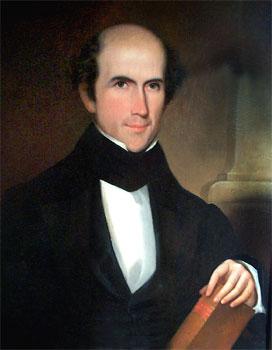
Thomas H. Benton: the fury of Missouri

Image from bioguide.congress.gov

Charles Lucas, a U.S. attorney for the territory of Missouri, should have taken a cue from his first major confrontation with Thomas Hart Benton. Lucas and Benton, a rival lawyer, had sparred bitterly in the courtroom but things had not reached a head until Benton insulted Lucas by quipping to a panel of judges that he did not "propose to answer any charges made by any puppy who may happen to run across my path." Lucas was angered enough that he demanded satisfaction, and met Benton at the popular "Bloody Island" dueling spot in August of 1817. The two men exchanged shots from 30 feet, resulting in a slight wound to Benton and Lucas nearly bleeding out through a shot to the neck. This was a rather telling example of Benton's skill with a firearm, and friends of Lucas grumbled that Benton had specifically demanded such a distance to increase his advantage over Lucas. Though Lucas himself never accused Benton of being unjust, he agreed to Benton's proposal that the two duel at nine feet to settle the rumors. At this second contest in September, Benton fatally shot Lucas in the heart. Lucas allegedly had harsh words that Benton persecuted and murdered him, but ultimately proclaimed his forgiveness of the man before he died.

It was not the first run-in with firearms Benton had in his life, and it would not be the last. The duel with Lucas soured him on the idea of ever killing another man, however, and he never took up another duel challenge in his life.

Benton was born near Hillsborough, North Carolina in March of 1782. He attended Chapel Hill College (later the University of North Carolina) as well as the College of William and Mary. He didn't finish his studies at either institution, since his father left behind a 40,000-acre estate in Tennessee when he died and Benton moved there with his family to help manage it. He was admitted to the bar at Nashville in 1806, and started practicing in Franklin. From 1809 to 1811, he served in the state senate and helped pass one law reforming the judicial system and another giving slaves the right to a jury trial in criminal matters.

Later, Benton served in the military as an aide-de-camp to General Andrew Jackson. He was a colonel of a regiment of Tennessee volunteers during the War of 1812, and appointed lieutenant colonel of the Thirty-ninth United States Infantry in 1813. It was in this same year that Benton's relationship with Jackson began to deteriorate. Benton's brother, Jesse, and a man named William Carroll were both slightly injured in a duel where Jackson acted as a second to Carroll. The incident led to a series of sniping verbal attacks between Benton and Jackson, culminating when Benton commented that he considered another man a superior officer to the general. Jackson threatened to publicly horsewhip Benton at their next meeting, but the encounter was not to go in his favor. In a brawl in Nashville in September of 1813 between Benton, Jesse, Jackson, and a handful of other people, Jackson was shot and wounded seriously enough that he had to be taken away from the scene. He left his small sword behind, and Benton reportedly broke it in the public square while continuing to denounce the general.

The incident did nothing to improve Benton's standing in Tennessee, as he found that Jackson's friends would make sure that he never had a political future in the state. Benton's solution was to move, and he relocated to St. Louis, Missouri in 1815. He continued to practice law, but also became an editor with the Missouri Enquirer. He equated the modern newspaper with the forums in ancient Greece and Rome, and became an outspoken author in a number of different political debates. In 1819, he voiced opposition to a treaty between the United States and Spain assuring the latter country that the U.S. would relinquish any claims to Texas the Louisiana Purchase had stirred up; he even went so far as to say that war with Spain over the issue would be "the most happy event for ourselves and the human race." Benton also supported the U.S. possession of Cuba, Mexican independence, trade with India via the Pacific Northwest, and the admission of Missouri as a state.

Benton got his wish in the last matter with the Missouri Compromise of 1820, which admitted the state alongside Maine to balance the free and slave states in Congress. In 1821, the newly formed legislature unanimously chose David Barton, speaker of the state house of representatives and president of the state's constitutional convention, to serve in the Senate. Members deadlocked on their second choice in the crowded field of candidates, which included Benton as well as Lucas' father. They turned to Barton for help, and he recommended Benton. The legislature approved Benton with 27 votes, seven short of a unanimous consensus, and Benton received the six-year term instead of the four-year term after drawing straws with Barton.

Benton spent the next 30 years in the Senate, first as a Democratic-Republican and later as a Democrat. During his time in the chamber, he chaired the committees on Indian affairs, military affairs, and foreign relations. In the first position, Benton was an advocate of Indian removal. He figured that such relocation would open the way for white settlement and the collection of natural resources, along with the strange justification that prohibiting Indians from having contact with whites would prevent them from becoming depraved. He said such policies were designed "to cherish and protect the Indians, to improve their condition, and turn them to the habits of civilized life," yet he also commented at another point that it freed the land of a "useless and dangerous population."

Land issues were especially close to Benton's heart. He supported land reform, namely a preemptive right to settlers, periodic price reductions of homesteads to allow prices to conform to the quality of the land, and donations of land to poor settlers to allow them to work it for a period of time as a way of payment. He also favored western exploration, especially the Pacific Northwest, but not so much that he joined the "fifty four-forty or fight" crowd who demanded a larger chunk of land during negotiations with Britain. In this regard, he helped to establish the present day 49th Parallel border with Canada.

The rift between Benton and Jackson healed with time. Benton lent his support to Democratic-Republican Representative Henry Clay of Kentucky in the 1824 presidential election, but later defected to Old Hickory. Jackson won the popular vote with 152,901 votes as well as the electoral vote, but none of the four candidates received a plurality. The matter had to be resolved in the House of Representatives, which awarded the White House to Secretary of State John Quincy Adams (who received 114,023 votes). As a further show of support, Benton backed a proposal to amend the Constitution to allow the popular vote to decide presidential contests.

Benton also sided with Jackson in his ongoing disagreements with Vice President John C. Calhoun of South Carolina. The chief issue between them was the question of nullification, or whether states had the right to overturn unpopular federal laws. Calhoun was specifically interested in disabling tariffs that were harmful his state, but Jackson and Benton both opposed nullification. Benton shared Jackson's distaste of the Bank of the United States, and launched several resolutions on the issue; these included one questioning whether the Bank's accounts were properly balanced and another requiring the Bank to compensate citizens for its use of public money. He became such a supporter of having gold back up accounts to avoid inflation through paper money that he was nicknamed "The Gold Humbug" by opponents, who began calling gold coins "Benton's mint drops." Supporters of the gold standard adopted the more complimentary nickname "Old Bullion" for the senator

Undoubtedly, Benton's most visible act of support for Jackson was also related to the Bank and financial matters. Jackson was elected President in 1828, and in 1832 he vetoed a congressional approval of the Bank's recharter and withdrew federal funds from the institution. Two years later, Congress censured him on the accusation of exceeding his authority. Benton immediately tried to get the resolution expunged, but it was shot down. He tried two other unsuccessful versions before a fourth one to expunge the censure resolution from the Senate Journal finally passed in January of 1837, with Jackson not far from retiring from his second term as President. The measure was controversial enough that Benton's friends tried (and failed) to persuade the senator to take up arms for his own personal protection, and Benton launched a few salvos at anti-Jackson "ruffians" in the galleries as the measure was going through.

Opposition to Benton at home grew strong enough at times to threaten his seat, but he was able to survive in Washington. Despite his earlier support of war to retain claims to Texas, he was nearly turned out of the Senate by voters for opposing the annexation of the territory. The criticism, he explained, was over where the territory's borders lay and the process of the land's acquisition rather than the annexation itself. He opposed the Mexican War, but supported a speedy end to the conflict once the first shots were fired. In Benton's mind, however, part of this process involved a leadership position for himself. He was able to pressure President James K. Polk into nominating him for as a commanding lieutenant general of all U.S. troops in the war, but he was never confirmed. Polk also considered him for a major-general position, but Benton declined to accept.

It was as a result of these machinations that Benton ran afoul of Henry S. Foote, a lawyer who became a Democratic senator and began serving in 1847. Foote first met Benton in 1837, and later wrote that while he and Benton agreed on several matters he considered the Missouri senator imperious and pompous. "On meeting him face to face my first unfavorable impressions of him were greatly strengthened," Foote said, "and the excessive vanity and egotism constantly displayed by him, both in conversational scenes and in the Senate, inspired me with feelings of disgust and aversion which I have seldom experienced." Foote criticized Benton's attempt for a command position as an "unjust and ungenerous" effort to suppress the leadership of General Winfield Scott. He raised a more serious accusation after the war ended in 1848, accusing Benton of procuring a meeting with the Mexican minister to try to rescind the treaty ceding the empire's northern lands to the United States. Foote's accusation was enough to get Benton voted out as chairman of the Committee on Military Affairs at the Democratic caucus, though Benton resigned the position once he got the news.

Benton had a rather curious opinion about slavery. He was certainly no abolitionist (he was, in fact, a slaveowner), but he described the practice as evil, saying during one debate, "The incurability of this evil is the greatest objection to the extension of it." The Missouri Compromise had banned slavery in the Louisiana Purchase territory north of Missouri's southern border, and Benton generally agreed that the practice should not be tampered with in areas where it existed, but also not expanded to new territories. One notable exception to this was the Wilmot Proviso of 1847, an ultimately unsuccessful proposal by Democratic Representative Daniel Wilmot of Pennsylvania to forbid slavery in the California and New Mexico territories seized in the Mexican War. Benton may have agreed with the sentiment, but felt it was a non-issue and "firebrand" resolution since slavery was already banned there under the laws of the former Mexican government. "The proviso was nugatory, and could answer no purpose but that of bringing on a slavery agitation in the United States; for which purpose it was immediately seized upon by Mr. Calhoun and his friends, and treated as the greatest possible outrage and injury to the slave states," Benton declared in his memoir, Thirty Years' View. Benton was strongly committed to preventing secession, to the point that a 1909 book, The South in the Building of a Nation, bluntly declared, "The reason Missouri did not secede was Col. Thomas Hart Benton."

A few years later, debates over the imminent admission of California as a free state led to heated debates over how best to handle the resulting slave vs. free state imbalance in Congress. Benton was opposed to the idea of taking on several proposals in a single bill, suggesting during the debates that the Fugitive Slave Law to return escaped slaves to the South was defective and proposing a bill to eventually divide Texas into two slave states. Foote continued to goad Benton, positing that Clay's support of a speedy California admission was a result of conversations with his son-in-law, John C. Fremont, who had taken on a few government posts in the territory and would be appointed a senator upon California's admission.

Foote had tried to get a rise out of Benton on plenty of occasions, possibly in an attempt to force the senator to pick up his dueling pistols once again. Though the compromise debates were raising plenty of tempers, the circumstances leading to confrontation between the two senators may have been a result of different issues. There are several different accounts as to what sparked the incident. Benton and Foote may have traded barbs over who was more cowardly, or Foote may have named Benton as lead "calumniator" of a lower class than those who signed Calhoun's "Southern Address." Foote recalls that it had to do with remarks over Calhoun, who died at the end of March of 1850. Benton certainly wasn't kind to the former Vice President on his passing, giving the opinion that he had been a key proponent of disunion. "There may be no vitality in his body, but there is in his doctrines," Benton opined. "The last thing I did before leaving home was to denounce him and his treasonable sentiments and I shall do the same thing when I return home...Calhoun died with treason in his heart and on his lips...Whilst I am discharging my duty here, his disciples are disseminating his poison all over my state." Foote said that Benton made further derogatory remarks in April, as Calhoun's body was being taken back to South Carolina. He said he tried to get Democratic Senator Andrew Butler of South Carolina to denounce Benton on behalf of his state, but that Butler wasn't sure what the issue was about when he did so. Foote said Benton's action came after he added his own words to strengthen the criticism.

Whatever the cause, the Senate remembered what came next fairly clearly. Benton was incensed enough that he shot up from his chair and began to rush toward Foote. The Missouri senator was a large, powerful man and that made any efforts to try to stop him all the more difficult. Foote retreated into the aisle, fearing that Benton would try to attack him as he'd threatened to do after earlier insinuations. He took out a pistol he had with him and kept the barrel pointed at the floor, but he later admitted that he would have shot Benton if he had advanced much farther than he did. The weapon only seemed to strengthen Benton's resolve, but he opted to keep his distance once it was out. He shouted that he did not carry any weapon, and dared Foote to carry out the deed, even opening up his vest to help his fellow senator find a target. "Let him fire!" he boomed. "Let the assassin fire!"

The matter resolved itself peacefully. Foote gave up the gun to fellow Democratic Senator Daniel S. Dickinson of New York, and it was locked away. Benton returned to his desk, shouting some more abuse at Foote before taking his seat. The matter was referred to a seven-man committee, which had to be appointed since no one wanted to volunteer and suffered from several members trying to withdraw. The lukewarm final report criticized the disorder and the presence of firearms in the Senate, but also found Foote innocent of any assassination attempt against Benton. The committee said it was the first incident of its kind in the Senate and announced the hope that it would be the last, recommending no further action on the idea that it would serve as "a sufficient rebuke and warning not unheeded in the future." Benton and Foote continued to snipe at each other, but never got into so severe an incident again. A retrospective by Joseph Morgan Rogers, friendly to Benton, declared Foote's behavior "the greatest indignity the Senate had ever known."

Benton's enemies finally ousted him in the election in 1850, and Whig candidate Henry S. Geyer took his spot. He wasn't out of Congress long, winning an 1852 election for a place in the House of Representatives. The New York Times gave the opinion that while they disagreed with Benton on most issues, they could still appreciate him as a politician. On one hand, he was "assuming, domineering, and even insolent to a most extraordinary degree, and generally contrives to make himself thoroughly uncomfortable to the party which he has always opposed, and which he will undoubtedly continue to oppose to the end of his life." At the same time, he was in favor of a federal democracy rather than states' rights, and therefore a "real Democrat. He is not shamming, or seeking simply selfish ends, as many of his party leaders are, in professing a belief in Human Rights." In addition to returning as chairman of the Committee on Military Affairs, he opposed the Kansas-Nebraska Bill to repeal the Missouri Compromise, criticizing it as another threat of disunion and a "bungling attempt to smuggle slavery" into the territories. He colorfully described the bill as a "shilly-shally, willy-won'ty, don'ty-can'ty style of legislation."

Benton lost the 1854 election to Opposition Party candidate Luther M. Kennett. He stayed in Washington, D.C. and turned to literary matters, completing an account of his 30 years in the Senate and working on a collection of abridged debates in Congress from 1789 to 1856. Unfortunately, a good portion of his manuscript papers were destroyed when his house burned down in March of 1855. He made an unsuccessful bid in Missouri's 1856 gubernatorial election, and was so committed to Jacksonian politics that he backed Democratic presidential candidate James Buchanan over Fremont, his son-in-law and the Republican candidate. Though he felt Fremont's election would inflame sectional differences, he ultimately became a critic of the Buchanan Administration and lent his support to the Republican Party in his waning days.

Benton died of cancer in April of 1858. The New York Leader eulogized him, saying, "He was an affectionate husband, a devoted father, a true friend, and a sincere Christian. In this respect his example is worthy the attention of all; and his memory will long be held in respect by a grateful country."

Sources: The Biographical Directory of the United States Congress, "Benton And Clay" in the National Era on Aug. 2 1849, "Benton In Congress" in the New York Times on Aug. 16 1852, "The Destruction Of Colonel Benton's House" in the New York Times on Mar. 1 1855, "Thomas H. Benton: Sketch Of His Life And Public Services" in the New York Times on Apr. 10 1858, Thirty Years' View by Thomas Hart Benton, Munsey's Magazine Vol. 58, The Life of Thomas Hart Benton by William Montgomery Meigs, Thomas H. Benton by Joseph Morgan Rogers, The United States Democratic Review Vol. 42 Issue 1, A History of Missouri by Eugene Morrow Violette, A History of Missouri: 1820 to 1860 by William Earl Parrish and Perry McCandless, The South in the Building of the Nation edited by Julian Alvin Carroll Chandler et. al., President Zachary Taylor: The Hero President by Elbert B. Smith, Henry Clay: Statesman for the Union by Robert Vincent Remini, Team of Rivals: The Political Genius of Abraham Lincoln by Doris Kearns Goodwin, Casket of Reminiscences by Henry Stuart Foote, My Quarter-Century of American Politics, Vol. 2 by Champ Clark, On the Brink of Civil War: The Compromise of 1850 and How it Changed the Course of American History by John C. Waugh

Saturday, August 7, 2010

Frank D. McKay: the Teflon boss

(Source)

Frank Donald McKay made plenty of enemies in his time as a political boss, but perhaps the most bizarre action by one of his foes came in October of 1935. McKay's maid called police after noticing that two men were peering at his house in Grand Rapids, Michigan, from a concealed position. When officers arrived, they found former police commissioner John Gillespie and a gas station employee spying on the residence. Both men were arrested, and police discovered that they had been armed with a rifle and pistol. Gillespie insisted that the weapons were for his own protection, saying McKay was a dangerous man. He blamed McKay and Republican Governor Frank Fitzgerald for his downfall after Fitzgerald repudiated him.

McKay had gradually built his empire to the point where he was capable of controlling much of the Republican politics in Michigan. He was born in Grand Rapids in 1883 and got his start working in furniture factories. He then built up his personal fortune by becoming a financier, extending into real estate, insurance, and banking interests. He also owned the Michigan Times and had holdings in lumber, tires, food, and numerous other areas. In addition to making him a millionaire, this extensive network helped him gain control over patronage jobs and public contracts in the Grand Rapids district. Though one retrospective said he spoke in "short, explosive phrases, usually profane," McKay was still able to form alliances on the local level and with other party bosses in the state. He once said he dedicated 95 percent of his time to business and only five percent to politics, but McKay's grip tightened to the point where he could sway the delegates to any candidate of his choice at the GOP state primaries.

McKay had not truly consolidated his power until the 1930s, but his first brush with the law came in November of 1919. He was one of 135 people indicted on corruption, fraud, and conspiracy charges. The focal point of these crimes was Republican Senator Truman H. Newberry, the biggest name of the defendants, and the charge that $500,000 to $1 million was improperly used to influence Newberry's re-election over Democratic candidate and automobile magnate Henry Ford in 1918. McKay was then serving as an assignment clerk in the Detroit courts, and charged with twice giving $10 to residents in "overt acts" of corruption. He was not convicted of the crime.

McKay's only real political office was state treasurer, which he held from 1925 to 1930. One year after he left, he was investigated by a grand jury over his handling of state funds, but never charged with a crime. He was still suspected of wielding excessive control over the governor's office, however. In 1935, Fitzgerald defended his relationship with McKay after Republican Representative Albert J. Engel warned that the GOP's chances of success in 1936 would be endangered if the party did not distance itself from McKay. Fitzgerald accused Engel of acting out of self-interest or making an attempt to discredit the current administration. "McKay is my friend," he said. "I don't say this is true of Congressman Engel, but I find that most of those who criticize him ask me to do things that Frank McKay would never dream of asking...The charge that this administration is hooked up with Frank McKay has been whispered constantly, but no one has ever produced definitive evidence of it."

Engel responded by demanding a full probe of Fitzgerald's activities. Though this apparently did not happen, Engel proved correct in his warning, at least as it related to the governor's office. In the 1936 race, Democratic candidate Frank Murphy made "McKayism" an issue and vowed to end it in state government; voters turned Fitzgerald out in November. McKay was investigated by the state legislature to see if his personal wealth correlated with his political activities, but once again no charges were forthcoming.

The year 1940 was a mixed bag for McKay. He retained enough power that he was able to convince Republican presidential candidate Wendell Willkie to grant him control of statewide patronage jobs if he were sent to the White House. At the same convention, however, anti-boss factions were successful in blocking him from getting a vote and preventing his re-election as Republican national committeeman. He was also subject to three grand jury investigations throughout the year related to fraud, extortion, and kickbacks. In November, Franklin D. Roosevelt bested Willkie for an unprecedented third term as President; the same month, McKay was indicted on charges of fraud and mail fraud. In one incident, he was accused of defrauding Edsel Ford of $9,918 to reimburse himself for contributions made to Fitzgerald's 1938 gubernatorial campaign. Two mail fraud counts said he collected money under false pretenses to finance the state Republican Party's debt. Another charge alleged that he tried to bilk Grand Rapids out of $300,000 in an approximately $2.2 million bond issue to finance a pipeline in 1938. And liquor issues resurfaced again, with prosecutors saying McKay collected $500,000 in tribute from 16 national distillers over five years.

The state's Liquor Control Commission had taken over bulk liquor purchases and retail licenses following the repeal of Prohibition. Not surprisingly, the three men on the board were McKay stooges, and distillers seeking business from the state had to go through the boss. McKay ensured that those friendly to the GOP got first consideration, while distillers considered more Democratic were bumped to the back of the line. It seemed likely that McKay collected a bit of cash in exchange for granting applicants access to the commission. After five days of deliberation in July of 1941, however, the jury had failed to reach a verdict. The jury was dismissed and subjected to a tampering investigation, but in May of 1942 McKay was acquitted along with seven co-defendants. The Edsel Ford charge was dismissed in July, and in October the pipeline count was dropped after the prosecutor determined that the chance of success at trial was too remote.

The result was a common one in McKay's repeated visits to the courtroom. The state could only prove McKay told state employees related to the liquor commission that their jobs depended on continued GOP success. Proving corruption was more difficult, but it didn't stop prosecutors from trying. In December of 1944, McKay was indicted alongside sports promoter Floyd Fitzsimmons and state representative William Green for bribery conspiracy. This time, McKay was charged with influencing the state legislature on an issue related to horse racing and parimutuel betting. The legislature defeated a bill aiming to boost state revenues from the activities, something which would have hurt the mob's stake in the sport. McKay was known to have connections to such gangsters, including the infamous Purple Gang, through their transition from illegal to sanctioned liquor sales.

The case had a dramatic ending. The state had targeted several people on corruption charges, charging some 50 people with crimes. State senator Warren G. Hooper, a legislator who had confessed to state corruption and agreed to turn state's evidence, was set to be the star witness in the trial of McKay and his cohorts. The state's case rested heavily on this man, and in January of 1945 he was found shot to death inside his burning car outside Springport. It was an indisputable gangland murder, and it received a bizarre twist when state attorney general John R. Dethmers charged widespread malfeasance at the Jackson State Penitentiary. Dethmers alleged that the inmates had essentially taken over control of the prison, with officials allowing them to pay for prostitutes to be brought in and accepting bribes to sanction escapes. In such an atmosphere, Dethmers said, it was entirely possible that imprisoned gangsters could have been granted a temporary release to murder Hooper, then return to the prison for a perfect alibi.

Four Detroit youths were charged with conspiracy in such a scheme. Prosecutors argued that one of the defendants was allowed to confer with members of the Purple Gang prior to the murder, and that the men conspired to arrange Hooper's death for a $15,000 payoff. The state made several thinly veiled accusations of McKay's involvement in the plot, though McKay himself was never directly charged. Dethmers said the murder was specifically meant to silence testimony against McKay, and special prosecutor Kim Sigler identified McKay as "the one man most interested in the death of the death of the Albion senator." The four men were convicted of conspiracy to commit murder in August of 1945 and sentenced to four-and-a-half years in prison each. No one was ever charged with the actual murder of Hooper.

The state launched one more salvo at McKay, once again charging malfeasance related to the liquor trade. In June of 1945, he and former Flint mayor William McKeighan, along with three other men, were indicted on a charge of conspiracy to violate state liquor laws. The group was accused of receiving a dollar a case from distillers for liquor sold in Michigan between 1938 and 1940. Distillers who wanted larger liquor orders from the state had forked over some $400,000, the state charged, and McKay and his co-defendants helped move things along by threatening and intimidating the commission.

The trial had to be moved after allegations of jury tampering. The state called 32 witnesses to the stand at the trial in 1946. The defense didn't call anyone, and the gambit worked. In February, the judge directed a verdict of not guilty after determining that the state failed to prove any criminal acts. Charges of bribery had been thrown out at the beginning of the trial, and that seriously undermined the conspiracy allegations. Moreover, the judge said it appeared to be a case of McKay and the other men trying to get increased sales and listings for the state liquor commission. Sigler argued that the outcome demonstrated a need for a law making it illegal to sell political influence, though enacting and enforcing such a law would be quite difficult.

McKay had also made an enemy in future president Gerald Ford. When Ford's stepfather advised him that he would have to earn McKay's favor if he wanted to get anywhere in Michigan politics, Ford went to meet with the boss. After waiting for several hours, McKay brushed him off after only three minutes. Angered, Ford joined the anti-boss advocates. He eased on these activities during World War II to join the military, but used this to his advantage when he returned to the state. As part of his campaign for the 1948 Republican nomination for the House of Representatives, he set up a red, white, and blue Navy surplus Quonset hut right outside McKay's office tower in Grand Rapids. In a sign of McKay's diminished power, he wasn't even able to kick the upstart candidate off his property. At the Republican primary, Ford ousted McKay's pick, 10-year incumbent Bartel Jonkman, Jr. and went on to win the general election.

McKay quietly disappeared from the political scene, and at some point he moved to Florida to continue business activities there. He died in Miami Beach in January of 1965.

Sources: The Political Graveyard, "Newberry And 133 Others Indicted For Election Plot" in the New York Times on Nov. 30 1919, "Gillespie Is Freed After Short Arrest" in the Ludington Daily News on Oct. 15 1935, "Engel's Talk Challenged By Governor" in the Ludington Daily News on Nov. 2 1935, "Engel Asks Probe Of McKay's Power" in the Ludington Daily News on Nov. 5 1935, "Business & Finance: Grand Rapids Heroism" in Time on May 25 1936, "House To Continue McKay Investigation" in the Ludington Daily News on Apr. 25 1939, "Michigan GOP Chief Indicted" in the Miami News on Nov. 27 1940, "Study Further Action Against McKay" in the Ludington Daily News on Nov. 28 1940, "Grand Jury Resumes Investigation Into Jury" in the Ludington Daily News on Jul. 23 1941, "GOP Committeeman Acquitted Of Fraud" in the Reading Eagle on May 26 1942, "Dismiss McKay Mail Fraud Charge" in the Milwaukee Journal on Jul. 18 1942, "McKay Freed Of Last Count" in the Milwaukee Journal on Oct. 15 1942, "Jury Accuses Politics Figure" in the Milwaukee Journal on Dec. 3 1944, "Michigan State Senator, Witness In Probe, Slain" in the Evening Independent on Jan. 12 1945, "Politician Held In Bribe Plot" in the St. Petersburg Times on Jun. 17 1945, "Blow Lid On Orgies In World's Largest Prison" in the Lodi News-Sentinel on Jul. 25 1945, "Four Detroit Hoodlums Convicted In Murder Plot" in the St. Petersburg Times on Aug. 1 1945, "Judge Orders Frank McKay Freed Of Conspiracy Charge" in the Ludington Daily News on Feb. 14 1946, "Sale Of Political Influence Leads To Drive For Curbs" in the Milwaukee Sentinel on Dec. 8 1947, "The Shaping Of The President: Ford's Early Years" in New York Magazine on Aug. 26 1974, Gerald R. Ford by Douglas Brinkley, Time and Chance: Gerald Ford's Appointment with History by James M. Cannon, The Powers That Punish: Prisons and Politics in the Era of the "Big House," 1920-1955 by Charles Bright

Thursday, July 22, 2010

William W. Rose: beer bandit

Image from kckpl.lib.ks.us

History has been kind to William Warren Rose. Though his decision to flaunt a court order may not have put him in the best light, his expulsion from office was a politically-tinged affair resulting in his refusal to uphold an unenforceable law.

Rose was born in Oyster Bay, New York in March of 1864. As a child, he moved to Ogdensburg and later spent time in New York City apprenticing in architecture with G.A. Schellinger. Rose left to start an independent practice in Birmingham, Alabama and partnered with Charles E. Reid. The business was a successful one, and received contracts for several public buildings including a hospital, college, and church. Rose then moved again, settling down in Kansas City, Missouri in 1886 to partner with James Oliver Hogg. Their business extended to the city of the same name in Kansas, and Rose relocated there in 1896. He ran for mayor almost immediately, appearing in the 1897 contest as a fusion candidate.

Rose did not win in that year, but succeeded in the race almost a decade later; it was the first of several times in a two-year span when he appeared as a candidate. In April of 1905, he was elected on a Democratic ticket after establishing a platform urging public rather than private ownership of municipal infrastructure such as the water company and the electric grid. After the election, Rose found that buying out the Metropolitan Water Company was more complicated than he expected due to tax methods and limited debt allowed for the city. He settled for an ordinance allowing a buyout for cost of construction with franchise value excluded. The measure was debated for 10 months, but the city finally purchased the company. William Elsey Connelley wrote in his history of Kansas that Rose had "shown a practical energy and a common sense attitude towards public affairs which have won him a large and loyal following and has made him a leader properly credited with much of the material advancement of Kansas City." However, Rose also got on the bad side of businesses such as packing houses and railroads controlled by Republican political bosses who had managed to avoid their fair share of taxes, by firing the tax assessor. Rose's allies blamed these foes when the mayor was targeted for his involvement in a rather common practice.

A nationwide prohibition on the consumption of alcohol was still several years away, but Kansas already had a law on the books making it a dry state. The prohibition wasn't very strictly enforced, however, and Rose even announced during his campaign that he had no intention of upholding this particular law. In Kansas City alone, some 150 saloons kept the liquor flowing. Varying practices existed in the state to ensure that the saloons paid de facto liquor licenses in exchange for continued operation, such as arresting a barkeep, collecting bail, and keeping it when the person didn't bother to show up in court. Such bartering could easily lead to money going into private hands, but Rose tried to ensure that it would go to the municipal coffers.

When Kansas City was targeted for stricter enforcement, Rose was one of the louder protesters. He argued that prohibition would have little effect on actually stopping the liquor traffic, and that those who fancied a drink would simply take their money to Missouri. By his calculations, the city would lose lose over $100,000 a year in indirect liquor license fees with stricter enforcement. As saloon crackdowns made this financial squeeze a reality, diminished property values and the city's inability to push the tax rate past an established limit forced Rose to slash the budget. He cut about half the police budget and two engine crews in fire department, suspended street cleaning operations, laid off several city engineers, and asked higher-paid city employees to accept voluntary salary reductions.

Worse still for the mayor, the Kansas Supreme Court took him to task for his failure to enforce the prohibition. The court accused him of collecting $50 monthly contributions from the violators without ever informing the county attorney of the infractions. The justices said he had failed to enforce anti-gambling laws as well. A lawsuit seeking his ouster was filed against Rose in September of 1905, and in January of 1906 the court approved the action. In April of 1906, liquor issues proved a major point in the aldermen elections and the officials brought in were opposed to Rose. Three days before the court injunction was to go into effect, Rose and police chief Vernon J. Rose resigned.

With a special election set for May, Rose once again ran for mayor to fill the vacancy caused by his own resignation. Republican councilman Edward E. Venard was named acting mayor and served about a month before becoming his party's mayoral candidate. Council president Joseph C. Laughlin became acting mayor for all of four days before the election. Rose's name wasn't even on the ballot due to the court's ouster decision. Nonetheless, he earned a plurality of 1,600 votes over Venard and Socialist candidate David Harris. In the midst of the year, which was quite a tumultuous one for Rose, the Democratic state convention nominated him for a House of Representatives seat by one vote; Rose opted not to accept.

The Kansas Supreme Court was none too pleased with Rose's victory. The mayor said that his resignation nullified the ouster, and that even if it remained in effect he was serving in the capacity of his latest election rather than the one in 1905 . He had been duly elected, Rose argued, and the court had no right to take him out of office. The court did not agree, and in July it fined him $1,000 for contempt for holding office despite the ouster. Rose needed to pay the fine within 20 days or else face jail. His defense attorneys successfully filed a writ of error, staying the judgment and allowing him to continue his duties as mayor. In September, however, both Mayor Rose and Police Chief Rose resigned, along with police captain John F. Kelly, in exchange for the court dropping its contempt investigations against the trio. One month later, the U.S. Supreme Court declined to take up the matter, leaving the Kansas Supreme Court's ruling in effect.

Laughlin once again took over the office, this time holding it from September until a special election in December. Rose was debarred from holding the mayor's office until after the term he was elected to expired. Instead, he backed Democratic candidate M.J. Phelan. Victory in the December election went to Dr. George M. Gray.

Rose returned to architectural work after his time in office, starting work with David P. Peterson in 1909. The partners won contracts for several more public buildings, including schools, libraries, and hospitals. He remained involved in politics to some degree, serving as a member of the Government War Labor Board during World War I. He made an unsuccessful bid for the state senate in 1916, and was a delegate to the Democratic National Convention in 1920.

Rose died in May of 1931. Writing in the Kansas City Kansan, A.E. Neal declared, "W. W. Rose was perhaps the boldest and most original political thinker that has attracted attention in Wyandotte County."

Sources: The Political Graveyard, The Kansas Collection at the Kansas City Public Library, "Results Of Prohibition" in the Feilding Star on Jan. 27 1906, "A Temperance Defeat" in the New York Times on Apr. 4 1906, "Ex-Mayor Rose Of Kansas City Re-Elected" in the Deseret News on May 9 1906, "Jail Threat For A Mayor" in the New York Times on Jul. 6 1906, "Rose Gets A Writ" in the Deseret News on Jul. 12 1906, "Mayor Rose To Quit" in the New York Times on Sep. 7 1906, "Mayor Must Pay $1,000 Fine" in the New York Times on Oct. 23 1906, A Standard History of Kansas and Kansans, Volume 4 by William Elsey Connelley, The Public Vol. 9 edited by Louis Freeland Post and Alice Thatcher Post and Stoughton Cooley, The Lawyers Report Annotated Book 6 edited by Burdett A. Rich and Henry P. Farnham

Friday, July 9, 2010

Harry S. Dent: the bad footnote

Image from washingtonpost.com

Were it not for a driver who accidentally struck and killed the beloved family dog of Harry Shuler Dent, Richard Nixon may not have become President. 

To be sure, Nixon was already trying to think of a way to court Southern votes as the 1968 election approached. The death of the dog provided an opportunity for him to get his foot in the door and make a gesture to Dent, then serving as a top assistant to ultraconservative and segregationist Senator Strom Thurmond, a Republican from South Carolina. Nixon sent the Dent family a new dog, and it won him a meeting. Dent told Nixon that the way to prevent a segregationist third party bid from siphoning off Republican votes was to win Thurmond's loyalty.  The very next day, he had the opportunity to do so. When a reporter asked him if he was embarrassed to share a party with Thurmond, Nixon replied, "Strom is no racist. Strom is a man of courage and integrity." 

It paid off for Nixon. During the 1968 primaries, Dent was initially supportive of then Governor Ronald Reagan of California, but swung his support to Nixon at Thurmond's urging. Thurmond himself led Nixon's campaign in the South, covering quite a bit of ground in the final months of the campaign to stump for him. Dent stayed in the background to some degree. In 1967, South Carolina Democratic executive director Donald Fowler accused Dent of "impugning the honesty of the Democratic Party" and demanded an apology. Dent responded by saying Fowler "should develop a tougher hide if he wants to survive in politics." 

Yet in the next year, Dent was himself demanding an apology from Democrats after black baseball legend Jackie Robinson accused Thurmond and Nixon of being racist and commented, "We might as well die in the streets fighting for our dignity as men as fight in Vietnam for freedoms we don't have for everybody at home." Dent responded, "The Democratic Party owes the people an apology. They are responsible for what Robinson said." 

Dent did have some role in organizing support for Nixon's nomination. Nixon won support easily in the South, as Reagan was ambivalent about running for the nomination and Governor Nelson A. Rockefeller of New York was seen as a more liberal supporter of civil rights. 

Dent was born in St. Matthews, South Carolina, in February of 1930. He graduated from Presbyterian College in Clinton, South Carolina, in 1951 and went on to serve in the Army during the Korean War. For a time following his service, he worked as the Washington correspondent for several Southern newspapers and radio stations. He attended school at night, earning degrees from both George Washington University and Georgetown University Law School in 1959. 

Dent spent a decade with Thurmond, starting a few years after Thurmond's 1948 bid for President on a segregation plank. He played a major role in getting Thurmond to switch parties from Democratic to Republican, and also helped the senator in his record-breaking filibuster against a civil rights bill in 1957. Dent's actions then included keeping a pitcher of orange juice offered by a senator away from Thurmond so he wouldn't have to use the bathroom, and waiting outside the Senate chamber with a pail just in case Thurmond couldn't make it to a toilet following the day-long harangue. 

Dent's political strategy for the South had its roots in 1964, when he campaigned for Republican candidate Barry Goldwater. The election marked a shift away from traditional Republican stances, as Goldwater opposed civil rights and spoke out in favor of states' rights. Goldwater lost the election, but carried five states in the Deep South. The next year, Dent became the chairman of the South Carolina Republican Party and remained there until 1968. One notable action during his chairmanship was his opposition to a legislative bill which would allow a stock car race to take place in Darlington on a Sunday. Dent argued that the bill "violates our traditional observance for the Sabbath day at a time when too many other important American traditions are being extinguished for the purpose of expediency and obvious personal gain." 

After Nixon was elected in 1968, he appointed Dent was a special counsel and political adviser. He and Nixon immediately had to deny that the appointment was a reward for Thurmond's help in getting Nixon elected, and moderate Republicans worried that Dent would prove as much of a right-wing ideologue as Thurmond. Dent sought to assuage such fears, insisting that he answered to Nixon and not Thurmond. "I recognize that this country is bigger than the South and that the President has to have a stance that's national," he said in a 1969 interview with Time. "The thing that would do me the most harm would be if I took up the South's cause, waved the Confederate flag, and ran all through the White House yelling and being parochial." 

Contemporary accounts suggested that Dent was proving true to his word, and that he was able to mesh well with Nixon without going too far to the right. In 1971, he even tried unsuccessfully to get the South Carolina Republican executive committee to name a party chairman who would be more moderate on racial politics. 

However, the stances masked a more racially charged "Southern strategy" concocted by Dent. Nixon would deny that there was any ulterior motive to this strategy, declaring that "this Administration has no Southern strategy but rather a national strategy which, for the first time in modern times, includes the South rather than excludes the South." Dent worked as a liaison between the White House and various Republican groups around the country. He blamed Democrats for creating social programs that put a drain on middle class, and said that under the party's leadership the country was "filled with radical dissenters, cities were literally burning down, crime seemed uncontrollable." 

Though the "Southern strategy" never overtly identified itself with racial politics, it essentially sought to capitalize on Southern disillusionment with the Democratic Party. The Democrats traditionally attracted Southerners, but support waned following President Lyndon B. Johnson's civil rights efforts such as the Civil Rights Act of 1964 and Voting Rights Act of 1965. A key component in winning over the South was an effort to assure Southerners that the White House would not overtly pursue civil rights issues, that it would appear to be supportive but not follow through on such matters. Edward Morgan, an assistant to Dent, summed it up in a memo to Nixon: "If we can keep the liberal writers convinced that we are doing what the Court requires, and our conservative Southern friends convinced that we are not doing any more than the Court requires, I think we can walk this tightrope until November, 1972." 

Dent urged Nixon to make conservative, pro-segregation appointments to the Supreme Court, including Clement F. Haynsworth, Jr. and G. Harrold Carswell. He also suggested to White House department heads that appointing white Southerners should be a top priority. The racial component of the strategy did not exactly go unnoticed at the time. Clarence Mitchell, a lobbyist with the National Association for the Advancement of Colored People, complained in late 1969 that Dent and other Nixon aides were hostile to the organization. Dent was not well-liked by liberals and moderates, and a 1969 Time article said people of those political persuasions considered him a "Southern-fried Rasputin in the White House." 

Dent's official title went through a few changes over the years, as he went from a special counsel to a deputy counsel and received a promotion to "chief political troubleshooter" in May of 1969. In 1970, he had to handle a minor flap involving his own actions when it was found that he wrote letters on White House stationary to blacks approached by his brother's home construction business. Dent denied that the letters were meant to help his brother's business, but rather to show that the Nixon Administration was fully supportive of federal programs for low-cost housing. Most of his brother's homes were financed through such programs, and though Dent denied that his brother requested that he send the letters he did say that his sibling complained that Democrats were getting most of the credit for such programs. Dent said he sent the letters because he "was interested in laying to rest any question as to where Richard Nixon stood on this program." 

At the close of 1972, following Nixon's re-election, Dent left his post to return to his law practice in Columbia, South Carolina, despite a request by Nixon to stay on in a promoted capacity. He announced that he was doing so because his key goal had been to help Nixon into a second term, he wanted to be closer to his family, and he wanted to distance himself from politics. Despite this last point, he said he would help Nixon or South Carolina Republican candidates if asked and often had to deny rumors that he would fill one of the numerous posts vacated in the wake of the Watergate scandal, or that he would run for governor or the Senate. 

In one odd advocacy move, Dent urged Fred B. Dent, who was no relation to Harry but had been named Secretary of Commerce after Nixon's re-election, to run for governor of South Carolina. Before long, Dent was serving as general counsel for the Republican National Committee. 

In 1974, the year rumors had him aiming for political office, Dent was caught in the expanding Watergate imbroglio. One of the practices uncovered in the investigation was Operation Townhouse, an illegal effort that raised $3 million for GOP candidates in 1970. The operation, so named because it ran from the basement of a private townhouse, essentially provided a slush fund with the goal of blackmailing recipient politicians if it ever came to it. The scheme was a violation of the Corrupt Practices Act, which forbid unregistered campaign groups from providing money in two or more states without first filing financial reports. 

Operation Townhouse was established by Nixon aide H.R. Haldeman, with Nixon calling the shots on who would receive funding. Dent admitted that he helped select which candidates would receive money, but did not know where the money was coming from. 

Dent was given the choice of going to trial on a felony charge of pleading guilty to a misdemeanor. He chose the latter in December of 1974, admitting to a violation of federal campaign finance laws. He was sentenced to one month of unsupervised probation. He resigned from his post in the Republican National Committee as a result of the conviction. The court also netted Nixon's personal attorney, Herbert W. Kalbach, and another aide, Jack A. Gleason. 

Contemporaries were rather sympathetic to Dent. Political columnist Jack Anderson said Dent's role in the scandal was minimal and "like his mentor [Thurmond], is personally regarded as honest, even by his enemies." Anderson alleged that Dent had even privately denounced the "dirty tricks" in the White House and that such corruption spurred his departure from his post there. Judge George L. Hart, Jr. commented, "It does appear to be as if Mr. Dent were more of an innocent victim than a perpetrator." Dent thanked Hart for the light sentence, but also bemoaned that he would be associated with Watergate and said, "I'm destined for the history books as a bad footnote." 

Dent said he initially wanted to fight the charge, but was advised against it by his attorneys. He explained his reasoning in racially tinged terms, declaring, "I realized that if I went to trial in Washington, D.C., this old boy with the Southern accent wouldn't have a chance before an all-black jury."  

Dent's guilty plea was followed by a probe to see if he would be disbarred, but nothing came of it. He worked for the presidential campaigns of Gerald Ford and George H.W. Bush. Dent also helped cripple John B. Connally's bid for the 1980 Republican nomination by associating him with blacks and gays; Connally grumbled that Dent was the "original dirty trickster." 

Dent turned his focus to religion, closing his law practice in 1981 and going into the Southern Baptist ministry. Following the fall of Nicole Ceausescu, Communist leader of Romania, Dent made several mission trips there to establish churches and orphanages. He helped to organize the first Senate prayer breakfast in 1989. 

Dent ultimately wrote five books. In one, he claimed the Southern strategy was meant to fight bias against the South, but when he started his ministry he admitted that he helped exploit racism to benefit Nixon. "When I look back, my biggest regret now is anything that stood in the rights of black people," he said. "Or any people" 

Dent died in Columbia in September of 2007 due to complications from Alzheimer's disease. 

Sources: "Dent: Kill Raceway Bill" in the Sumter Daily Item on Feb. 15 1966, "Apology Asked Of Harry Dent" in the Herald-Tribune on Sep. 7 1967, "Thurmond To Head Nixon Campaign" in the Rock Hill Herald on Sep. 10 1968, "Dent Asking An Apology For Robinson" in the Rock Hill Herald on Oct. 23 1968, "Dent Says New Post No Reward To Strom" in the Sumter Daily Item on Dec. 4 1968, "Thurmond Aid Is Nixon Troubleshooter" in the Toledo Blade on Jun. 14 1969, "Nation: Up At Harry's Place" in Time on Jul. 11 1969 "Black Leader Calls Nixon Aides Hostile" in the Milwaukee Journal on Dec. 28 1969, "Dent Sends Double-Barreled Letters" in the St. Petersburg Times on Jun. 27 1970, "New Moderates Seem To Be Raising Their 'Ugly' Heads" in the Tuscaloosa News on Jan. 24 1971, "A Who's Who Of Prominent Republicans" in the Miami News on Aug. 21 1972, "Harry Dent Says He's Returning To S.C. Law Firm" in the Herald-Journal on Dec. 3 1972, "Harry Dent: President Won't Name Candidate" in the Herald-Journal on Dec. 3 1972, "Dent Says He's Leaving Post In Administration" in the Rock Hill Herald on Dec. 4 1972, "Dent Mentioned For Governor" in the Herald-Journal on Feb. 11 1973, "Harry Dent Thinks He's Not Considered" in the Herald-Journal on May 2 1973, "Washington Merry Go Round" in the Bangor Daily News on Nov. 22 1974, "Former Nixon Aide, Dent, Gets One Month Probation" in the Lewiston Daily Sun on Dec. 12 1974, "Ex-Nixon Aide Pleads Guilty" in the Reading Eagle on Dec. 12 1974, "Dent Faces Probe" in the Times-News on Jan. 10 1975, "Nixon Strategist To Seek Ford Votes" in the Sumter Daily Item on Jun. 12 1976, "Harry Dent" in the Herald-Journal on Nov. 8 1988, "Dent Set Stage For Political Upheaval" in The State on Jan. 21 2005, "Harry Dent, An Architect Of Nixon 'Southern Strategy,' Dies At 77" in the New York Times on Oct. 2 2007, "Harry Dent; Advised Key Republicans" in the Washington Post on Oct. 3 2007, "The Lives They Lived" in the New York Times on Dec. 30 2007, Nixon's Civil Rights: Politics, Principle, and Policy by Dean J. Kotlowski, From George Wallace to Newt Gingrich: Race in the Conservative Counterrevolution 1963-1994 by Dan T. Carter, President Nixon: Alone in the White House by Richard Reeves, Nixonland: The Rise of a President by Rick Perlstein

Tuesday, June 22, 2010

Benjamin G. Harris: two dollar treason

Image from findagrave.com

When several Southern states broke off from the Union following Abraham Lincoln's election as President, a sizable portion of people in the North were fine with letting them go. Their demands for peace grew louder as the war to preserve the Union grew longer and deadlier. Though government officials were largely behind the war effort, some demanded peace on the floor of Congress. One such representative, Democrat Alexander Long of Ohio, made such a speech on April 8, 1864, advocating recognition of the Confederacy. He accused Lincoln of scheming to start the war by provisioning Fort Sumter in South Carolina, leading to a Southern attack on the outpost and the subsequent start of the war. Long also opined that after three years of conflict, the only options left for the country were complete subjugation and extermination of the South or recognition of the Confederate States of America as an independent nation. Such talk was not well-received, and the House of Representatives took up discussion the next day on whether to expel Long for treasonable utterances.

Benjamin Gwinn Harris, a Democratic representative from Maryland, came to Long's defense during discussions the next day. He declared that he had long been the only member of the House favoring peace with the South via recognition, and welcomed Long as "another soul saved." Harris also announced his support for slavery and said he had owned slaves until Union general Benjamin Butler seized them. He said the Bible sanctioned slavery, and that the argument of abolitionists that slavery was an odious practice transferred the label onto "honest and upright men" who owned slaves, such as himself and his deceased father. "You may consider it a sin as between you and your God," he said, "but you shall not use insulting language upon such a subject as that without being called to account."

The congressional record shows that Harris's speech was met with quite a bit of derisive laughter, particularly when he said his peace stance made him more pro-Union than the other men in the chamber. "I am not here for war, and will not be here for war, so long as I have a heart humane and Christian, when war is carried on upon such principles. No, sir, war never did and never will bring your Union together in such a manner as to be worth one cent," he said. "I am for peace, and I am for Union too. I am as good a Union man as any of you. I am a better Union man than any of you." What truly got Harris in trouble, though, was his remark that the Confederacy "asked you to let them go in peace. But no; you said you would bring them into subjection. That is not done yet, and God Almighty grant that it never may be. I hope that you will never subjugate the South."

While the rest of his speech only earned him contempt, this portion led to a call for Harris to be expelled. Democrat Fernando Wood of New York declared during the ensuing tumult that the House should throw him out as well, since he fully endorsed Long. Though Elihu Washburne, a Republican from Illinois who supported the expulsion measures, promised to put Wood out as well, no vote was ever taken on that representative.

The vote to expel Harris narrowly missed the two-thirds majority needed to do so. Eighty-four were in favor of the action, while 58 were opposed. The House then took up a particularly strongly worded resolution to censure him. Declaring that he had made treasonable statements and committed a "gross disrespect to this House," the action sought to have him "very severely censured" and declared "an unworthy member of this House." The action carried 98 to 20, after an unsuccessful attempt to table the resolution and two failed efforts to adjourn. Long was also censured in a resolution declaring him an "unworthy member of this House" in an 80-70 vote on April 14.

The incident was the first time that Harris, an unabashed secessionist, got in trouble in the House for his actions. Born in Leonardtown, Maryland in December of 1805, he attended Yale University in Connecticut and the Cambridge Law School in Massachusetts. He wasn't admitted to the bar until 1840, and by that time he had already been a member of the Maryland house of delegates in 1833 and 1836. He was elected to the House of Representatives in 1862, and the censure didn't stop him from returning at the 1864 election.

Harris got in even more hot water when the war ended in Confederate defeat exactly one year after his censure. On April 26, 1865, former Confederate soldiers Richard Chapman and William Read visited Harris at his home. The two paroled soldiers asked Harris to stay at his residence, since they were going to another location on a pass but had grown tired. Harris was reluctant to accept the soldiers, given his position in the government and the Union suspicions his sympathies to the Confederacy had earned him. Instead, Harris gave the men a dollar each for lodging. They stayed at a place about a mile and a half away, using the money for the evening's shelter and a meal.

Harris was surprised when in May he was arrested on a charge of harboring the Confederate soldiers. The real motivation for the arrest, however, lay in the discussion he had with the soldiers at his doorstep. He was charged with not just giving the soldiers money for a roof over their head, but advising them to keep up the fight for the Confederacy. The penalty for such disloyalty could be as severe as death.

Harris was quickly court-martialed by the War Department and tried in a military court in Washington, D.C. In addition to relieving the two Confederate soldiers with money, the court charged, Harris was charged with "advising and inciting them to continue in said army, and to make war against the United States, and emphatically declaring his sympathy with the enemy, and his opposition to the Government of the United States in its efforts to suppress the rebellion." Harris protested that a court-martial was not appropriate, since he was in no way connected with the U.S. armed forces. He admitted that he gave the soldiers the money to pay for lodging so he wouldn't get into trouble with the authorities. He also said it had already been proven that the soldiers were not lodged where they said they had bunked down for the evening.

Chapman confirmed that Harris had been reluctant to lodge them due to scrutiny by federal authorities. A native of Baltimore, Chapman left the loyal state of Maryland to join the Confederate Army. As per the surrender arrangements, soldiers who had deserted the United States to fight for the South needed to take an oath of allegiance to the United States before they were allowed to go home. Chapman, who lost five brothers to the war, said he would go home to Baltimore if he could take the oath. Harris said that Chapman could go wherever he wanted since he was on parole, and Chapman replied that he'd seen a notice saying the oath was a requirement. Harris bitterly responded that paroled soldiers ought to be able to go home anyway and that Union general Ulysses S. Grant was a "damned rascal" if he didn't allow it.

Chapman said Harris got much more expressive on the state of affairs in the nation, praising the cause of the Confederacy as just and Confederate president Jefferson Davis as a great leader and true Southern gentleman. He suggested that Chapman not take the oath, since he was sure many other soldiers would refuse it, but instead be exchanged to keep up the fight for the South. Perhaps worst of all, during a discussion of Republican President Abraham Lincoln's assassination Harris commented that the death had come too late to do the rebels any good. Read also recalled that Harris was reluctant to lodge the men but urged them to keep fighting for the Confederacy. A Union sergeant who arrested Harris said that the congressman had admitted to giving the soldiers money. Though he hadn't admitted that he urged the men to keep fighting, he did complain that the abolitionists were interfering too much with post-war affairs.

Harris was swiftly found guilty of violating the 56th article of war and sentenced to three years in prison. Though this conviction forever disqualified from holding any office in the United States government, a reprieve came within weeks. President Andrew Johnson, Lincoln's Republican successor, issued an executive order on May 31 approving, confirming, and then remitting the sentence. Johnson said the order to remit was due to "additional evidence and affidavits...bearing upon this case and favorable to the accused, having been presented to and considered by me, since the sentence aforesaid."

Harris was released and allowed to return to Congress. At the commencement of a session in December, Republican Representative John F. Farnsworth asked the Committee on Elections to look into Harris's qualifications for the seat. He cited the court-martial, sentence disqualifying him from office (which he argued had been confirmed by Johnson but not remitted), and the statements about Lincoln's assassination as being inconsistent with the oath of office. The committee never reported back, and the House never took a vote.

At the expiration of his term in March of 1867, Harris left Congress for private life. However, he periodically made public statements on the dead cause of slavery. In September of that year, he strongly opposed a new state constitution for Maryland on the argument that it conceded too much to liberal Republicans by abolishing slavery and conforming to the Civil Rights Bill, which declared "that no person shall be incompetent as a witness on account of race or color, unless hereafter so declared by act of the General Assembly." The constitution, he said, was an "abomination" and would "place us on an inclined plane which leads directly and irresistibly to the foul slough of radicalism." That same year, the New York Times described him as "the representative man of the old pro-slavery Democrats yet alive in the state."

In 1874, Harris unsuccessfully sought the Democratic nomination for his district's House race. Here, he focused on the Fourteenth Amendment (which included citizenship for any person born in the United States, enforcement of civil rights, and prohibitions against elected officials who took an oath of office and joined the Confederacy) and the Fifteenth Amendment, which gave voting rights to former slaves. Both amendments, Harris said, were "utterly void."

In 1892, at the age of 86, he was still beating the same drum. In that year, he sent a petition to Congress on behalf of himself and other residents in Maryland asking to be compensated for slaves who had been freed by state or federal law.

Harris died on his Leonardtown estate in April of 1895.

Sources: The Biographical Directory of the United States Congress, "A Member Of Congress In Trouble" in the London Evening Advertiser on May 3 1865, "Treason At Home" in the New York Times on May 5 1865, "Treason At Home" in the New York Times on May 7 1865, "Treason At Home" in the New York Times on May 13 1865, "The Case Of Benj. G. Harris" in the New York Times on Jun. 5 1865, "Hon. Benjamin Harris On The New Maryland Constitution" in the New York Times on Sep. 12 1867, "Maryland" in the New York Times on Oct. 26 1867, "General Notes" in the New York Times on Jun. 14 1874, "Contested Election" in the Deseret News on Jun. 27 1874, "Wednesday In Washington" in the New York Times on Mar. 24 1892, Reports of the Committees for the House of Representatives for the First Session of the Forty-Third Congress, On the Resolution to Expel Mr. Long speech by Benjamin G. Harris, The Dark Intrigue: The True Story of a Civil War Conspiracy by Frank Van Der Linden, The Great Conspiracy: Its Origin and History by John Alexander Logan, The House: The History of the House of Representatives by Robert Vincent Remini, The Political History of the United States During the Great Rebellion by Edward McPherson

Friday, June 11, 2010

Jim West: surfing wipeout

Image from nytimes.com

Some eight years before voters kicked him out of office for ethical issues, James West weathered a criminal charge to keep serving in the Washington state senate. In 1998, the Building Industry Association of Washington ran in ad in a local newspaper suggesting that West wasn't supportive of education. In response, West phoned up the lobbying group's leader, Tom McCabe, and left a message seething, "McCabe, you son of a bitch, you better get me 'cause if you don't you're dead."

When the message was made public, West tried to argue that he meant McCabe would be politically deceased, not physically killed. McCabe brought a criminal harassment complaint against the legislator, and West ended up paying $500 to an Olympia charity. He also paid $250 in court costs, served nine months of probation, and apologized to McCabe and the Spokane community in general. It wasn't the first time West's temper got the better of him. In 1995, he swore at fellow senator John Moyer and his staff after Moyer implied that West didn't support a $2 million appropriation for Spokane's Cheney Cowles Museum. West kicked Moyer's office door during the outburst, and apologized for that incident as well.

West was born in March of 1951 in Salem, Oregon, and attended school in Spokane. After going to the University of Nevada and its Reserve Officer Training Corps, he served in the Army as a paratrooper with the 82nd Airborne Division. He moved to North Carolina to work as an assistant manager in a retail scuba diving store, returning to Spokane in 1974 to pursue a career in law enforcement. He joined the Medical Lake Police Department as a patrolman in 1975, transferring to the Spokane County Sheriff's Office at the end of the year. He opened his own scuba shop in 1977, graduating from Gonzaga University the next year with a bachelor's degree in criminal justice. He was later sued for wrongful death when a student on a dive he was supervising died, but the case was thrown out since the student had signed a consent form.

In 1979, West became the sergeant-at-arms for the Washington house of representatives. The next year, he went into politics himself, becoming the youngest member of the Spokane City Council at age 28. He won an election to fill a vacancy in the house of representatives in 1982, and four years later he moved over to the senate. He spent 20 years in the state legislature, but made a few efforts to get out. He ran unsuccessfully for lieutenant governor in 1996 and mayor of Spokane in 2000. West gained a good deal of influence in the legislature. He successfully proposed extending the state's motorcycle helmet law to all riders, not just juveniles, and helped to create the state's Department of Health. Earning more mockery was a 1990 suggestion that teenage sex be criminalized. One prosecutor jokingly suggested that a bill preventing legislators from procreating with each other would be more beneficial.

In 2003, West was elected mayor of Spokane over Democratic candidate and journalist Tom Grant. In April, West had announced that he had colon cancer. After his victory, he was frequently absent due to surgical procedures. While in office, he managed to pull together support for a $117 million bond issue to repair the city's streets, despite a recent defeat of a similar measure. He also helped get the city out of a failed venture to create a parking garage, advocated a downtown wireless network, worked to prevent the closure of Fairchild Air Force Base, and cut down on city jobs to trim the budget.

Two years after his election, the Spokane Spokesman-Review assessed the mayor as having a fairly successful political record; it also had him on the ropes, fighting calls to resign. An 18-year-old man told the paper that he met the mayor through Gay.com, a homosexual online dating site. His date confided that he was the mayor of Spokane and, after a dinner date, the two had consensual sex. To test the claim, the Spokesman-Review hired a forensic computer expert to set up a sting. Using a profile to pose as an 18-year-old man, reporters chatted with the mayor online, where he identified himself as Cobra82nd and RightBi-Guy. “Remember, I’m very closeted. No one knows I like guys. Except the few guys I’ve been with and highly trusted,” West said in recorded instant message conversations. He offered the nonexistent teen a few perks to try to get him to city hall, including an internship, trips to sporting events, and autographed sports memorabilia.

On May 5, 2005, the newspaper published a major report detailing their findings. Prominently featured were accusations by two men who said West molested them when he was a sheriff's deputy and they were boys. They accused another man, David Hahn, of the same conduct. Hahn also served as a deputy, but didn't have anything to say for himself; similar accusations had already come up over two decades before the scandal, and Hahn had committed suicide with his service weapon in 1981. West knew he was caught, and admitted to reporters that he had been looking for men on Gay.com for a year. "I can't tell you why I go there, to tell you the truth...curiosity, confused, whatever, I don't know," he said of his online dating. Though he did not admit that he was gay, West didn't shy away from a suggestion that he was bisexual. He firmly denied that he ever abused any children, and the accusers' claims were compromised somewhat by the fact that they were both convicted felons and drug addicts.

Within a couple of days, two more men came forward with allegations that West sexually abused or made passes at them in 1980 and 2001. Some politicians said that West's sexuality was something of an open secret, with his proposal to a woman on the floor of the legislature and subsequent five-year marriage working as a ruse to combat such allegations. Past opponents had never used the issue for political fodder, feeling it didn't relate to the political issues at hand. The publicized charges crossed into ethical territory, however; a city councilwoman said that West had admitted to her that he used city computers for the chat rooms and masturbated to them in his City Hall office. When the Spokesman-Review printed this charge, West called them up to deny her account. "I'm being destroyed because I am a gay man, which is fine. I've been in public life, I can accept that. Because I am a gay man, because of this double life, it has been hell," he said. "It's OK to destroy me, but stop destroying this city." The mayor also complained that the newspaper had "brutally outed" him.

West's plight didn't earn him much sympathy in the gay community, as the scandal also exposed him as something of a hypocrite. While in the legislature, he was a conservative Republican well-known for his focus on moral issues. Besides his proposal to criminalize teen sex, he was also opposed to the distribution of information packets on AIDS and was strongly against any measure related to gay rights. He co-sponsored an unsuccessful bill in 1986 to bar homosexuals from employment in schools, day care centers, and some state agencies; the bill was a retaliatory measure against a gubernatorial Christmas order in 1985 prohibiting such discriminatory practices in state hiring. He supported the Defense of Marriage Act to ban gay marriage, and in 1998 Washington became the 27th state to adopt the measure. West explained that he wasn't necessarily opposed to gay rights, but didn't want to create "special classes" for any minority.

One of the more immediate effects of the scandal was West's removal from affiliation with the Boy Scouts of America. He had been volunteering for the organization for over 30 years, but chose to resign from the Inland Northwest Council of the Boy Scouts and the board of directors for Morning Star Boys Ranch, which serves 18-year-olds from troubled backgrounds. One official with the Boy Scouts bluntly said that West would have been kicked off the council if he hadn't resigned, due to the organization's stance against homosexuality and immediate revocation of such offices if there are allegations of sexual abuse. West announced that he would take a leave of absence to prepare a defense, and left deputy mayor Jack Lynch in charge. "Finally, I hope that you and the people will reserve judgment on me until the newspaper is done persecuting me and allow me to have the fair opportunity to respond to each of the allegations in due time," he concluded as he left office. By the end of the month, however, West was back in City Hall. Meanwhile, the Federal Bureau of Investigation began looking into his computer records.

West's colleagues weren't exactly happy to see him return, and the calls for his resignation increased. Business leaders said such an action would limit any potential damage to tourism and the city's image. The city council tied 3-3 in a vote to ask him to take administrative leave, failing only because the members opposed wanted a stronger motion. Not long after, in June, the council voted unanimously to recommend his resignation, a first step toward possible impeachment. A few days later, West made an apology but vowed to stay in office. He said former Democratic President Bill Clinton and former Democratic Washington Governor Mike Lowry both survived sex scandals. "I did things in my private life that I should have known if they became public would cause embarrassment…everyone makes mistakes. I do, too," he said, adding that the ordeal "has been an embarrassing, humiliating and painful experience. But it doesn't need to distract this city." The Lowry example only gave more ammunition to those who saw West as a hypocrite. Investigators found insufficient evidence to prosecute Lowry after a female aide accused him of sexual harassment, but the governor chose not to run for re-election in 1996; at the time, West sent a letter to the speaker of the state house of representatives demanding a swift impeachment process. There was some speculation that West was reluctant to give up the office due to its lucrative $136,000-a-year salary, and even more so for the health benefits covering his cancer treatments.

West also fought an ongoing recall effort against him, which charged that the offers made to the phony 18-year-old represented "an improper exercise of an official duty." His lawyers argued that the recall lacked legal justification and that the judge who first heard the case got personally involved by rewriting the recall proposition. The state supreme court upheld the recall effort, saying the recall process could proceed if it gathered enough signatures. It eventually collected 17,121, a healthy margin greater than the minimum amount at 12,567. A recall election was scheduled for December.

Two months prior to the election, it was determined that West used city computers to browse gay profiles for men in Philadelphia and Washington, D.C., when he went to the cities on business. Ironically, one of the people he met in D.C. was Larry Craig, the Idaho senator who would get caught up in his own gay sex scandal in 2007. Around the same month, West said he was contemplating filing suit against the Spokesman-Review based on allegations that they broke federal and state laws regarding privacy issues and computer trespass. "Basically, the reason I'm bringing a lawsuit is, nobody, public or private, should go through what the Spokesman-Review has done to me as far as invading my privacy," he said. The suit never materialized.

In late November, a private investigator hired by the city council reported that West broke the law by hiring a man for the city's Human Rights Commission and then pursuing him sexually, and broke city policy as well by browsing online for gay men. As the countdown to the recall proceeded, West fought to keep his computer records private. He argued that some of the images from Gay.com were automatically downloaded to his computer's browser cache. Only a few days before the recall election, the findings were publicized. They showed that in three months, West spent hours on the site; 6,626 images were downloaded from Gay.com, and some of them were explicit.

Sixty-five percent of the voters agreed to kick West out of office. Dennis Hession, the city council president, took over the mayor's duties. "There have been a lot of lessons out of this, to tell you the truth," West said. "It's helped me straighten out my personal life." Curiously, West said that he stood by his previous anti-homosexual stances, with the exception of the one to prevent homosexuals from working in schools and other institutions involving children. Gay and lesbian groups saw the scandal a different way, saying it had the effect of encouraging openness rather than closeted lives. West said he was resigned to the vote, but the next day he sniped, "I think there are people in this community that could do a better job [as mayor] than anyone on the city council."

In February of 2006, the FBI wrapped up their probe and concluded that there was insufficient evidence to file any charges against West. Their investigation looked only into fraud related to whether he offered jobs or internships in exchange for sex. State charges remained an option, with the city's investigation alleging a violation of a state law that officials could not use municipal computers for personal use. Local prosecution got bogged down, with the county prosecutor having a conflict of interest due to a past $50 contribution to West's campaign, the local police unwilling to proceed, and the city officials not keen on pressing the issue. West ultimately ended up getting a job selling advertisements for a Seattle magazine, and chatted with a radio station about a possible talk show.

West said he wasn't ruling out another bid for office, but his recall came when he had less than a year to live. His cancer spread to his liver while in office, and he died in July of 2006 after complications from surgery.

Sources: "Senator Settles Charge Filed By Lobbyist" in the Moscow-Pullman Daily News on Nov. 10 1998, "Race To Lead Spokane" in the Spokesman-Review on Oct. 19 2003, "West Tied To Sex Abuse In '70s, Using Office To Lure Young Men" in the Spokesman-Review on May 5 2005, "West's Public Policy Conflicts With Private Life" in the Spokesman-Review on May 5 2005, "Online Relationships" in the Spokesman-Review on May 5 2005, "West Has Brought New Tone, New Success To City Hall" in the Spokesman-Review on May 5 2005, "After Spokane Childhood, West Leads Life Of Service" in the Spokesman-Review on May 5 2005, "Spokane Mayor's Accusers Are Felons" in the Ellensburg Daily Record on May 6 2005, "West Resigns From Scout Post, Boys Ranch Board" in the Spokesman-Review on May 6 2005, "West Faces New Allegations" in the Spokesman-Review on May 7 2005, "Rodgers: West Used City Office" in the Spokesman-Review on May 8 2005, "West Denies Having Online Sex In Office" in the Spokesman-Review on May 8 2005, "Mayor Says Sex Act Happened At Home" in the Spokesman-Review on May 9 2005, "Mayor To Take Leave" in the Spokesman-Review on May 10 2005, "Spokane Mayor Urged To Resign" in the Eugene Register-Guard on May 15 2005, "Council Split On West" in the Spokesman-Review on May 16 2005, "It's 'Awkward' With Mayor Back At City Hall" in the Spokesman-Review on May 20 2005, "Spokane Finds It Tough To Get Rid Of Mayor" in the Ellensburg Daily Record on May 28 2005, "Council Wants West Out" in the Spokesman-Review on Jun. 1 2005, "'Everyone Makes Mistakes'" in the Spokesman-Review on Jun. 4 2005, "West Urged Quick Justice In Lowry Sex Scandal" in the Spokesman-Review on Jul. 14 2005, "West Recall Advances" in the Spokesman-Review on Aug. 25 2005, "17,121 Urge West Recall Vote" in the Spokesman-Review on Sep. 22 2005, "West Accessed Sex Sites On Trips" in the Spokesman-Review on Oct. 15 2005, "Spokane Mayor May Sue Paper For Privacy Invasion" in the Seattle Post-Intelligencer on Oct. 22 2005, "West Says Downloads Automatic" in the Spokesman-Review on Nov. 16 2005, "Spokane Mayor's Offer Broke Law, Report Says" in the Seattle Times on Nov. 21 2005, "West Spent Hours Online At Gay.com" in the Spokesman-Review on Dec. 3 2005, "Voters Recall West" in the Spokesman-Review on Dec. 7 2005, "Spokane Mayor, Caught In Gay Sex Sting, Is Ousted In Vote That May Advance Gay Rights" in the New York Times on Dec. 8 2005, "West Challenges Successor" in the Spokesman-Review on Dec. 8 2005, "No Federal Charges" in the Spokesman-Review on Feb. 17 2006, "No Charges After Investigation Of Ex-Mayor's Online Scandal" in the New York Times on Feb. 17 2006, "Prosecution Of Former Spokane Mayor Appears Unlikely" in the Seattle Times on Mar. 22 2006, "Former Spokane Mayor Jim West Dies" in the Seattle Times on Jul. 22 2006

Monday, May 31, 2010

Charles A. Hayes: bounced out

Image from bioguide.congress.gov

Before he came to the House of Representatives as an elected member, Charles Arthur Hayes appeared in Congress to defend himself against accusations of Communism. In 1959, 57-year-old Joseph Poskonka told the House Un-American Activities Committee that he had endured insults and beatings for 16 years as a member of the Communist Party. The reason he did so was not out of a strong devotion to the party's ideals, he testified, but because he was an informant for the Federal Bureau of Investigation assigned to infiltrate the United Packinghouse Workers of America union and report on any Communist activities there. He told the committee that the union was rife with such subversion, and that Communists were trying to take over areas of American industry related to food production in order to tamper with it should the country go to war with the Soviet Union.

Poskonka identified Hayes as one of several union leaders in the Communists' pocket. Hayes, then serving as district director of the United Packinghouse Workers of America and vice president of the Illinois state AFL-CIO, was summoned to Washington to testify before the committee as part of a three-day hearing focusing on the UPWA. He invoked his Fifth Amendment right against self-incrimination eight times when questioned on any past involvement with the Communists. He did choose to denounce the movement and say he was not a Communist at that time. The Fifth Amendment declaration unnerved AFL-CIO officials enough that they asked Hayes to step down from his state position, but he refused. Congress did not press Hayes on his activities, and the matter faded away.

Hayes was involved with union activities for most of his life. Born in Cairo, Illinois in February of 1918, he graduated from high school in 1935 and went to work as a railroad section hand. From there, he went to work with a flooring company and organized a successful strike in 1938. Following this victory, he formed a union of black carpenters and joiners and served as its president from 1940 to 1942. The union later opened up to white workers as well.

Hayes transferred his union activities to the meatpacking industry after leaving the flooring company to become a fresh pork worker. He joined the grievance committee of the United Packinghouse Workers of America union in 1943, became a field representative for it in 1949, and served as district director from 1954 to 1968. He later served as vice president of the Amalgamated Meat Cutters and Butcher Workmen of North America union, and held the same post in the United Food and Commercial Workers Union. This latter organization was the largest one included in the AFL-CIO, and he remained there from 1979 until his retirement in 1983.

Though Hayes pushed for the traditional goals such as improved working conditions and better wages and benefits, he was also active in civil rights. He fought for desegregation in the dressing rooms and cafeterias of the meatpacking industry, as well as improved advancement opportunities for black workers. He sought to get women and blacks to serve as leaders in labor unions, and in 1972 he joined other black labor leaders in a Miami Beach conference to form a coalition in support of Democratic presidential candidate George McGovern to counter opposition by some white labor leaders. He organized rallies in support of the Montgomery bus boycott and provided financial support and manpower for events organized by civil rights leader Martin Luther King, Jr.

In April of 1983, two-term congressman Harold Washington was elected the first black mayor of Chicago. He resigned his seat in the House of Representatives, and a special election was scheduled for August to fill the vacancy. Thirteen candidates threw their hats in the ring for the Democratic nomination in July, but Hayes had a special advantage. He supported Washington in his 1977 attempt at the mayor's office, as well as the successful 1983 campaign. In return, Washington threw his support behind Hayes. This angered many of the other candidates, who charged Washington with using machine tactics such as intimidation to ensure a Hayes victory, but they conceded that they would support Hayes if he won the nomination. Hayes came away with the Democratic nod after securing 45 percent of the vote. This election essentially guaranteed his entry into the House; the district was mostly black and strongly Democratic, and in August he got 94 percent of the vote after running against Republican candidate and newspaper columnist Diane Preacely.

It was the first of five consecutive victories in the House elections. After the 1983 election, Hayes announced that he was serving notice on Republican President Ronald Reagan. Saying that Reagan's cuts to anti-poverty programs had left one-third of the nation's blacks under the poverty line, he declared, "We must replace him with a chief executive who is committed to solving the problems of poor people. We've got to put America back on the track of greatness." His other goals upon entering office included a reduction in unemployment, which was especially burdensome in his district; a bilateral freeze on nuclear weapons; a national health service; and shifting funds from military budget to aid domestic programs. He authored the Dropout Prevention and Reentry Act to provide $500 million in federal funds to state and local governments to cut down on the dropout rate, which was also especially high in Chicago. He got in another jab at Reagan along the way, saying the President's cuts to education were “a callous disregard for the dreams and aspirations of millions of poor and disadvantaged children and young adults.” Hayes also sponsored numerous bills to try to decrease unemployment rates and provide relief for workers laid off in massive plant closings in Chicago. One of these bills, the Income and Jobs Action Act of 1985, sought to boost the provisions of 1978 Humphrey Hawkins Full Employment and Balanced Growth Act to increase employment opportunities with the growth of productivity.

In his continuing advocacy of civil rights, Hayes ran up against the law soon after his re-election in November of 1984. He had introduced legislation to impose economic and diplomatic sanctions against South Africa to get that country to end the discriminatory practice of apartheid. The Reagan Administration disagreed with taking a harsher stance, feeling that change could be achieved through diplomatic efforts. As a result, Hayes and several others took part in large-scale protests at the South African Embassy at the end of the month to protest apartheid, seek the release of several black labor unionists jailed in that country, and pressure the White House into changing the diplomatic stance and putting sanctions into place. Numerous people were arrested due to violations of a city code forbidding protesters from being within 500 feet of an embassy. Secret Service agents arrested Hayes inside the embassy itself after he entered along with Reverend Joseph Lowery, the head of the Southern Christian Leadership Conference. Immediately before the arrest, Hayes told reporters that he could not sit idly by while racist policies stood and that he was hoping to end "the atrocious situation in South Africa." He was released immediately after the police booked him on a charge of misdemeanor unlawful entry. Numerous other high-profile people were arrested in the protests, including several Democratic congressmen and Yolanda King, the daughter of Martin Luther King, Jr. Within days of his arrest, the charges against Hayes and 10 others were dropped.

Shortly before Hayes' bid for the Democratic nomination in 1992, he was named in a wide-ranging scandal in the House. The Sergeant at Arms provided an informal banking service, and dozens of representatives had written bad checks on insufficient funds in the bank; the New York Times said the practice "effectively resulted in interest-free loans." Some representatives had only written a few checks in this way, but others had overdrawn hundreds. Hayes was among the worst offenders, with the House Ethics Committee reporting that he wrote 716 bad checks in a 39-month period. The news broke in March, in the last week of the primary campaign. Hayes said it wasn't much of an issue, since he had not broken the law or cost the taxpayers any money. "I want it clearly understood: I'm not a criminal, and I don't want to be treated like this," he said. Hayes' main opponent, Chicago alderman and former Black Panther Bobby Rush, had been arguing that Hayes had not achieved any significant legislative victories while in Congress and used the banking scandal to further support the argument. "Charlie Hayes' record in Congress is like his record of 700 overdrawn checks: insufficient ideas, insufficient commitment, insufficient action, insufficient funds," he said.

Other factors put Hayes' chances for re-nomination in jeopardy, namely a redrawing of congressional lines to change his constituency. However, the bounced checks received the bulk of the blame for his defeat. Even then, it was a fairly close contest. Rush received 42 percent of the vote, or 51,145 ballots, while Hayes came away with 39 percent, a total of 47,151 votes. Rush went on to win the general election, and has won every House contest in his district between 1992 and 2008. In 1993, the Justice Department cleared Hayes of any criminal wrongdoing in the banking scandal.

Hayes returned to work in labor and community matters in Chicago. He died of lung cancer in April of 1997. Two years later, the Charles A. Hayes Investment Center, a nonprofit technology center for underprivileged Chicago residents, opened in a building formerly used by the United Packinghouse Workers of America.

Sources: The Biographical Directory of the United States Congress, Black Americans in Congress at baic.house.gov, "Packer Union Leader Uses Fifth Eight Times" in the Chicago Tribune on May 7 1959, "Reds Run Union" in the Miami News on May 8 1959, "Hayes Asked To Quit AFL Post; Refuses" in the Chicago Tribune on May 20 1959, "Black Labor Group To Aid McGovern" in the Sarasota Herald-Tribune on Aug. 8 1972, "Union Urges Labor Dept. Rights Probe" in the Washington Afro-American on Feb. 13 1973, "Hayes Wins In Chicago" in the Pittsburgh Post-Gazette on Jul. 27 1983, "Chicago Primary Winner Tries To Ease Bitterness" in the Palm Beach Post on Jul. 28 1983, "Hayes Wins Special Election" in the Free Lance-Star on Aug. 24 1983, "Hayes Goes To Congress" in the Afro-American on Oct. 1 1983, "SCLC Head Arrested In Embassy Protest" in the Tuscaloosa News on Nov. 27 1984, "Two Congressmen Arrested In Protest Against South Africa" in the Ocala Star-Banner on Dec. 1 1984, "Arrests Continue In South African Protest" in The Telegraph on Dec. 1 1984, "Congressman Who Wrote Bad Checks Faces Voters Today" in The Dispatch on Mar. 16 1992, "Illinois Democrats Boot 5 Congress Incumbents" in the Pittsburgh Press on May. 18 1992, "Charles Hayes, 79, Former Chicago Lawmaker" in the New York Times on Apr. 13 1997, "Former U.S. Congressman Charles Hayes Dies at 79" in Jet on Apr. 28 1997